US Bishops United Against the HSS Mandate

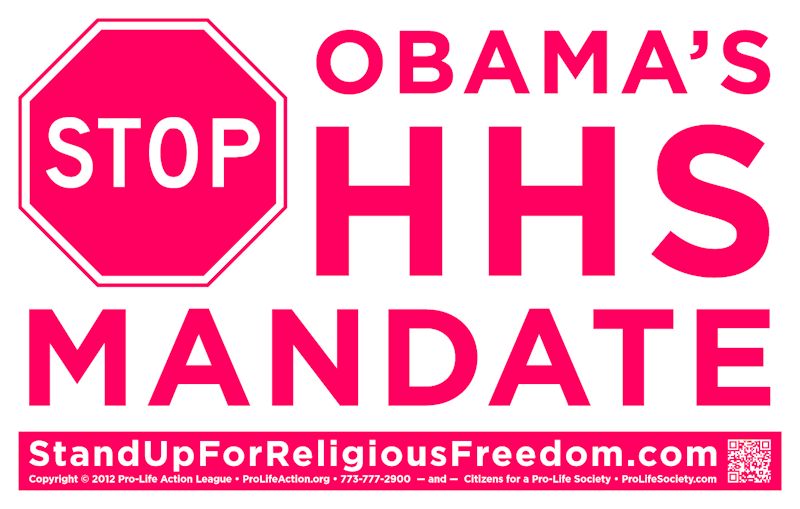
The US Bishops released a strong statement yesterday clarifying their stance on the HHS mandate.

United for Religious FreedomA Statement of the Administrative CommitteeOf the United States Conference of Catholic Bishop. March 14, 2012

 Excerpt

 “Second, we wish to clarify what this debate is—and is not—about. This is not about access to contraception, which is ubiquitous and inexpensive, even when it is not provided by the Church’s hand and with the Church’s funds. This is not about the religious freedom of Catholics only, but also of those who recognize that their cherished beliefs may be next on the block. This is not about the Bishops’ somehow “banning contraception,” when the U.S. Supreme Court took that issue off the table two generations ago. Indeed, this is not about the Church wanting to force anybody to do anything; it is instead about the federal government forcing the Church—consisting of its faithful and all but a few of its institutions—to act against Church teachings. This is not a matter of opposition to universal health care, which has been a concern of the Bishops’ Conference since 1919, virtually at its founding. This is not a fight we want or asked for, but one forced upon us by government on its own timing. Finally, this is not a Republican or Democratic, a conservative or liberal issue; it is an American issue.

 So what is it about?

 An unwarranted government definition of religion.) Read more…

We need to stand firm with our Shepherds and fight the good fight.

Posted in Catholic Church, Culture of Death, Freedom of Religion | Tagged | Leave a comment

The Contraception Mandate is Anti-Woman

Gloria Purvis makes the case against the HHS mandate. H/T Mark Shea

Posted in Catholic Moral Teaching, Church and the Public Square, Culture of Death, Freedom of Religion | Tagged | 1 Comment

The Silence of Jesus

The Pope has given us much to ponder on our desert journey. His recent catechesis focused on the importance of silence.

Excerpt:

This principle that without silence we neither hear nor listen nor receive the word _ applies above all to personal prayer, but it also pertains to our liturgies: in order to facilitate an authentic listening, they must also be rich in moments of silence and unspoken receptivity. St. Augustine_s observation forever holds true: Verbo crescente, verba deficient — _When the Word of God increases, the words of men fail_ (cf. Sermon288; 5: PL 38, 1307; Sermon 120,2: PL 38,677). The Gospels often present Jesus — especially at times of crucial decisions — withdrawing alone to a place set apart from the crowds and from his own disciples, in order to pray in the silence and to abide in his filial relationship with God. Silence is capable of excavating an interior space in our inmost depths so that God may abide there, so that his Word may remain in us, so that love for him may be rooted in our minds and in our hearts and animate our lives. The first way, then: to learn silence, [to learn] the openness to listening that opens us to the other, to the Word of God.

However, there is a second important element in the relation of silence with prayer. For in fact there exists not only our silence, which disposes us to listening to God’s Word; often in our prayer, we find ourselves before the silence of God; we experience a sense of abandonment; it seems to us that God is not listening and that He does not respond. But this silence of God – as Jesus also experienced – is not a sign of His absence. The Christian knows well that the Lord is present and that he is listening, even in the darkness of suffering, rejection and solitude. Jesus reassures the disciples and each one of us that God knows well our needs at every moment of life. He teaches the disciples: _In praying do not heap up empty phrases as the Gentiles do; for they think that they will be heard for their many words. Do not be like them, for your Father knows what you need before you ask Him_ (Matthew 6:7-8): an attentive, silent, open heart is more important than many words.

God knows us intimately, more deeply than we know ourselves, and He loves us: and knowing this should suffice. In the Bible, Job’s experience is particularly significant in this regard. This man quickly loses everything: family, wealth, friends, health; it seems that God’s attitude towards him is precisely one of abandonment, of total silence. And yet Job, in his relationship with God, speaks with God, cries out to God; in his prayer, despite everything, he preserves his faith intact and, in the end, he discovers the value of his experience and of God_s silence. And thus, in the end, turning to his Creator, he is able to conclude: _I had heard of thee by the hearing of the ear, but now my eye sees thee_ (Job 42:5): nearly all of us know God only through hearsay, and the more we are open to His silence and to our silence, the more we begin to know Him truly. This supreme confidence, which opens way to a profound encounter with God, matures in silence. St Francis Severio prayed, saying to the Lord: I love you, not because you can give me heaven or condemn me to hell, but because you are my God. I love You, because You are You. Read more…

Posted in Pope Benedict XVI | Tagged , , | Leave a comment

In the Desert of Lent

How is your lent going?

Well mine is a mixed bag. On the one hand I am going to daily Mass more often, and I have made progress on the issues that I needed to work on.

But I still flirt with spiritual sloth. I read about God all day long. But I am losing the battle of prayer. Yet I know deep in my mind, heart, soul and gut, that I can’t have a relationship with God if I don’t have a conversation with him every day. Conversation. Not monologue. I have to listen.

My favorite deacon and I have been married almost 39 years because we get that we have to take time to converse every day. But  do I get that my heart yearns to talk to God?

Jesus is not going to give me at theology exam at judgment day. I wish. I would pass with flying colors. Passing the Christian vocation to Agape. Not so much.

He is going to shine his light into my heart. Is he going to find darkness or light? Is he going to say you have been a good and faithful servant—a true friend, or is he going to say you are a fraud?

Lord Jesus have mercy on me a sinner. Please shine your light into the darkness of my heart so that I can learn to truly love you and my neighbor.

Posted in Holiness | Tagged | 2 Comments

Top Ten Bogus Arguments In Favor of the HHS Mandate

I hate the fact that the attack on religious freedom by the current administration is forcing me to (probably) vote for the not Obama candidate. Voting none of the above is no longer an option.

The American Catholic has a great post up which demolishes the 10 Most cited arguments in favor of the HHS Mandate.

H/T Mark Shea

Posted in Catholic Church Scandals, Culture of Death, Freedom of Religion | Tagged | 7 Comments

The Bishops Fight Obama for Religious Freedom

Well clearly I am not doing a very good job of blogging for lent.  Hey it is not easy being a DRE this time of year. Anyway while I was away from the internet the past few days, I missed this powerful letter from Cardinal Dolan to his brother bishops. The letter reveals the underlying danger of the birth control mandate.
Cardinal Dolan asserts that the Obama administration has dismissed the concerns of the bishops and has appointed their own magisterium.

excerpt:

“At a recent meeting between staff of the bishops’ conference and the White House staff, our staff members asked directly whether the broader concerns of religious freedom—that is,revisiting the straight-jacketing mandates, or broadening the maligned exemption—are all off the table. They were informed that they are. So much for “working out the wrinkles.” Instead, they advised the bishops’ conference that we should listen to the “enlightened” voices of accommodation, such as the recent, hardly surprising yet terribly unfortunate editorial in America. The White House seems to think we bishops simply do not know or understand Catholic teaching and so, taking a cue from its own definition of religious freedom, now has nominated its own handpicked official Catholic teachers.

We will continue to accept invitations to meet with and to voice our concerns to anyone of any party, for this is hardly partisan, who is willing to correct the infringements on religious freedom that we are now under. But as we do so, we cannot rely on off the record promises of fixes without deadlines and without assurances of proposals that will concretely address the concerns in a manner that does not conflict with our principles and teaching.

Congress might provide more hope, since thoughtful elected officials have proposed legislation to protect what should be so obvious: religious freedom. Meanwhile, in our recent debate in the senate, our opponents sought to obscure what is really a religious freedom issue by maintaining that abortion inducing drugs and the like are a “woman’s health issue.” We will not let this deception stand. Our commitment to seeking legislative remedies remains strong. And it is about remedies to the assault on religious freedom. Period. (By the way, the Church hardly  needs to be lectured about health care for women. Thanks mostly to our Sisters, the Church is the largest private provider of health care for women and their babies in the country.) Bishop William Lori, Chairman of our Ad Hoc Committee on Religious Liberty, stated it well in a recent press release: “We will build on this base of support as we pursue legislation in the House of Representatives, urge the Administration to change its course on this issue, and explore our legal rights under the Constitution and the Religious Freedom Restoration Act.”

Perhaps the courts offer the most light. In the recent Hosanna-Tabor ruling, the Supreme Court unanimously defended the right of a Church to define its own ministry and services, a dramatic rebuff to the administration, apparently unheeded by the White House. Thus, our bishops’ conference, many individual religious entities, and other people of good will are working with some top-notch law firms who feel so strongly about this that they will represent us pro-bono. In the upcoming days, you will hear much more about this encouraging and welcome development.

Given this climate, we have to prepare for tough times. Some, like America magazine, want us to cave-in and stop fighting, saying this is simply a policy issue; some want us to close everything down rather than comply (In an excellent article, Cardinal Francis George wrote that the administration apparently wants us to “give up for Lent” our schools, hospitals, and charitable ministries); some, like Bishop Robert Lynch wisely noted, wonder whether we might have to engage in civil disobedience and risk steep fines; some worry that we’ll have to face a decision between two ethically repugnant choices: subsidizing immoral services or no longer offering insurance coverage, a road none of us wants to travel.   Brothers, we know so very well that religious freedom is our heritage, our legacy and our firm belief, both as loyal Catholics and Americans. There have been many threats to religious freedom over the decades and years, but these often came from without. This one sadly comes from within. As our ancestors did with previous threats, we will tirelessly defend the timeless and enduring truth of religious freedom.” Read more….

Pray for our bishops. We all need to gird our loins. We are headed for long battle. At least I know who wins in the end. I read the end of the book.

Posted in Catholic Church, Culture of Death, Freedom of Religion | Tagged , | Leave a comment

Choice, Suffering and Original Sin

Simcha Fisher responds to the tragic story of a mother of a dying child who wishes that she had aborted him.  Freedom to choose is a dangerous illusion. H/T Little Catholic Bubble

Excerpt:

“She has had her face pushed against the wall of horror which is mortality.  She does not like the choices presented to her:  either suffer this way, or suffer that way.  What is her answer?  “There ought to be another choice.”  Choice after choice after choice.  The modern person confronts pain and slices it thinner and thinner, hoping to put an end to it.  This does not work.  It simply makes the pain, like a knife, sharper.

Am I implying that to know God is to be happy and contented?  Hell no.  The more we ask questions, the more we realize how small we are in the face of the answers.

But here is the folly of the modern American faced with ethical torment:  they think there is someone to blame.  It’s the Republicans’ fault!  It’s the pro-lifers’ fault!  It’s the tyranny of the Church, or the oppression of institutionalized sexism!

No.  It’s original sin that they don’t like.  Is it oppressive?  Hell yes.  Is it unfair?  Hell yes.  Is it inescapable?  Hell yes.  Sooner or later, all of us are faced with the crushing unfairness of life, and presented with a cleft landscape:  suffering on one side, suffering on the other.  God willing, when it’s my time, I’ll know enough to beg Him to make the choice for me.  Without God, our only option is to dive straight into the crevasse—too look into Hell, and to say to it, “Yes.”

We make our choice.”

I pray that when my time comes to make the choice between suffering and suffering that I have the fortitude to trust in God. The alternative is to listen to the father of lies.

Posted in Culture of Death, Pro life | Tagged , | 1 Comment

What Do you Worship?

Fr. Barron on the importance of the first three commandments. H/T New Advent.

Posted in Catholic Moral Teaching | Tagged , , | Leave a comment

Medical Ethics Journal Argues for Infanticide

The Journal of Medical Ethics recently published an article which argues that after-birth abortions, otherwise known as infanticide should be permitted. The abstract sums up the paper:

Abortion is largely accepted even for reasons that do not have anything to do with the fetus’ health. By showing that (1) both fetuses and newborns do not have the same moral status as actual persons, (2) the fact that both are potential persons is morally irrelevant and (3) adoption is not always in the best interest of actual people, the authors argue that what we call ‘after-birth abortion’ (killing a newborn) should be permissible in all the cases where abortion is, including cases where the newborn is not disabled.  Continue reading…


The most shocking thing about this article is that I am not shocked by it. The pro abortion argument is an arbitrary one. It is based not on what the clump of cells or fetus is–a human life–but on when a human life becomes a person. The pro abortion argument rests on the false premise that a human being only has rights when person-hood is conferred. For most abortion proponents, a human life only becomes a person when she is born. But that is just the current acceptable time to snuff out an innocent human being.

Further, most abortions are performed because a child is considered an impediment to the mother’s quality of life. If you are pro abortion, it makes a perverted kind of logic that infanticide is just as acceptable.

Slippery slope indeed.

Mother Mary pray for us!

Posted in Abortion, Catholic Moral Teaching, Culture of Death | 1 Comment

Discerning Hearts

Need a spiritual retreat?  Having trouble jump starting your Lent?  Check out this great blog, Discerning HeartsH/T Dr. Tom Neal.

Posted in Catholic, Evangelization | Leave a comment