Beatifications and Royal Weddings

Pope John Paul II was beatified on Sunday.

In his Sunday homily, Deacon Greg talks about Blessed John Paul II. It is a beautiful tribute.
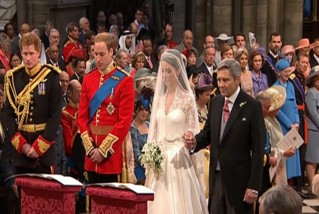
I didn’t pay attention to the wedding of William and Kate. But Frank Weathers posted the homily that was given at the ceremony, and it is surprisingly good.

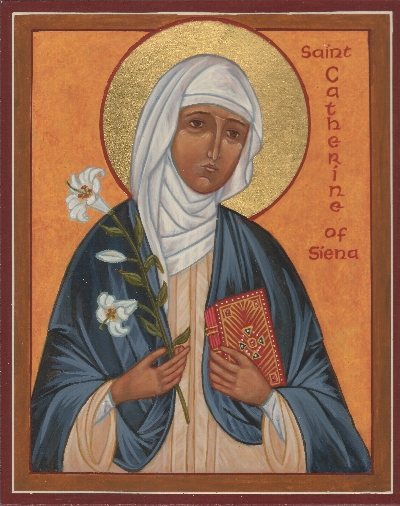
“Be who God meant you to be and you will set the world on fire.” So said St Catherine of Siena whose festival day it is today. Marriage is intended to be a way in which man and woman help each other to become what God meant each one to be, their deepest and truest selves.

Many are full of fear for the future of the prospects of our world but the message of the celebrations in this country and far beyond its shores is the right one – this is a joyful day! It is good that people in every continent are able to share in these celebrations because this is, as every wedding day should be, a day of hope.

In a sense every wedding is a royal wedding with the bride and the groom as king and queen of creation, making a new life together so that life can flow through them into the future.

William and Catherine, you have chosen to be married in the sight of a generous God who so loved the world that he gave himself to us in the person of Jesus Christ.

And in the Spirit of this generous God, husband and wife are to give themselves to each another.

A spiritual life grows as love finds its centre beyond ourselves. Faithful and committed relationships offer a door into the mystery of spiritual life in which we discover this; the more we give of self, the richer we become in soul; the more we go beyond ourselves in love, the more we become our true selves and our spiritual beauty is more fully revealed. In marriage we are seeking to bring one another into fuller life.

It is of course very hard to wean ourselves away from self-centredness. And people can dream of doing such a thing but the hope should be fulfilled it is necessary a solemn decision that, whatever the difficulties, we are committed to the way of generous love.  Read more here.

Posted in Catholic, Homily, Marriage | Tagged , , | Leave a comment

Beer Only Lenten Fast Results

Did you ever wonder how the beer only fast ended for J. Wilson?  Well it seems that it wasn’t as weird as I thought.

Eric Marrapodi, CNN Belief Blog Co-Editor has the answer. H/T Mollie of Get Religion.

Well he kept his beer only fast, and he benefited spiritually:

Wilson said the spiritual takeaway was threefold:

– “I just don’t think we give ourselves enough credit to accomplish difficult tasks. I think our bodies are capable of more than we ask of [them]. And certainly in relation to willpower – willpower related to food or willpower of how you’re going to conduct yourself spiritually – I think we can do more.

– “I noticed early on a difference between needs and wants. The first thing I noticed even in that first week, I got to the spot on day three when I wasn’t hungry any more, physically hungry. The aroma of food would kind of zap me and I would desire the cheeseburger that I smell or somebody’s chicken noodle soup across the office. So I didn’t need it but I wanted it. So there’s a difference between needs and desires.

– “The real challenge is it’s one thing to subscribe to beliefs, religion or otherwise, it’s another thing to apply them to your life every moment of your life. Part of that whole monk in the world philosophy I was exploring is can you live like a monk or believe like a monk and still navigate our crazy world? The ongoing challenge is you’ve got these beliefs, now fine. Live it.”

Who knew? I feel bad for making light of his unusual fast. Mea Culpa.

Oh and it seems that his health is okay.

From a health standpoint, Wilson seems no worse the wear. He began the fast at 160 pounds and finished up at 135. He saw his doctor Wednesday morning and was told everything looked good for now, pending the results of blood tests.

If you’re wondering if Wilson will ever drink beer again after living on nothing but beer for 46 days, he said he’ll probably take a break from doppelbock, but on Easter Sunday he brewed 10 more gallons of a different recipe.  

You can read the whole article here.

I have a feeling that my favorite deacon would like the guy.


Posted in Catholic, Liturgical Year | Tagged , , , | Leave a comment

Should Christians Celebrate the Killing of Bin Laden?

In a word no.  But I must confess that my first reaction to the news was an enthusiastic, finally!

I am such a poor Christian.

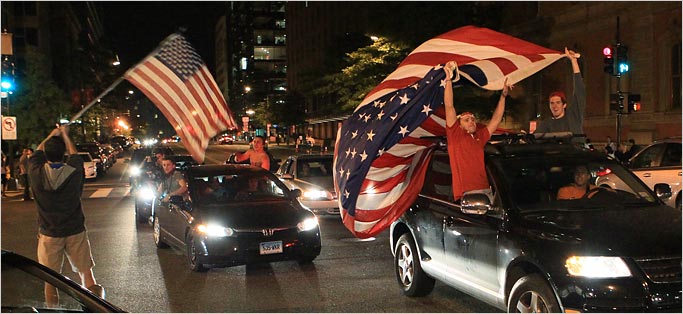
While elation at the death of a man who was responsible for the evil deeds of 9/11 is understandable, Christians should be repelled by the images flashing across our television screens, and news paper web sites, of rejoicing in the main streets of America.

A man was killed. A man. Not a monster. Osama was created in the image and likeness of God.  Yes that sacred image was grossly distorted by his evil deeds, but the image remained.  Hitler, Stalin, Bin Laden committed monstrous atrocities as human beings.   There are no monsters in our midst.

His killing might very well be justified under Catholic Just War doctrine, but I can not as faithful Christians celebrate the taking of human life.

And I certainly can not wish that anyone, no matter how evil their actions, ends up in hell for all eternity.

But I should pray for Osama’s eternal soul.  Christ demands that I forgive my enemies.   Hate is a destructive force. It eats away at the soul.

I have written about forgiveness here and here.  Forgiveness is not easy. It takes courage and virtue and most of all God’s grace.

I pray, therefore,  for Osama that he will receive mercy even though he showed no mercy for his victims.

Posted in Christianity, Difficult questions, Forgiveness | Tagged , , | 7 Comments

All That is Unseen

In the Nicene Creed Christians profess their belief in “all that is, seen and unseen”. 

In his book, The Invisible World: Understanding Angels, Demons, and the Spiritual Realities That Surround Us, Anthony Destefano  has written a guide book into the mysterious unseen world.

His purpose in writing the book is to make the spiritual world more visible . Destefano asserts that readers will become more familiar with the invisible world and thus realize that it is a reality.

The book is an easy read written in a conversational style.  Still the author asserts that his arguments are based on “solid theology common sense and logic, and backed up by biblical scholarship and the universal teaching of the Christian church over the past two thousand years”.

The book is well organized in ten chapters:  The Haunt detector, the Invisible God, Invisible Helpers: The World of the Angels, Invisible Evil: The Devil and His Demons; The Invisible Soul; Invisible Warfare: The Diabolical Battle for Souls; Invisible Grace; The Invisible Power of Suffering; Invisible Destiny: Death, Judgment, Heaven and Hell; Seeing the Invisible.

This is an excellent book for Christians who want to understand the spiritual world and are not inclined to read scholarly works. It is well written, and it is based on scripture and sound theology.

As a Catechist, however, I found Destefano’s reliance on anecdotes frustrating.  Further when referencing scripture and other sources, he usually does not cite his sources. For example, on page 50 ,in the chapter on angels , he correctly states that Scripture implies that every individual has a personal guardian angel, but he does not cite the verses.  Consequently a reviewer on the books Amazon  page, asserts that the author gets his theology on angels from “Touched by An Angel on the Hallmark Channel”.

The scripture citations for the existence of guardian angels are found in the footnotes of the Catechism of the Catholic Church (paragraph 336).

While the lack of footnotes or citations makes the book more accessible, omitting them is an obstacle to convincing those who reject the reality of the invisible world of angels and demons. Unfortunately, therefore, the author does not live up to his promise that his arguments are based on logic and solid theology and backed up by scripture and Church teaching.  They are but the proof is not provided in this book.

Caveats aside, I still highly recommend this book to believers who want to learn more about the mysterious world of the unseen. The author does indeed bring the mysterious world of the unseen to life.

Disclosure: I was given this book by B&B Media group to review. There were no restrictions placed on me. This is an honest review.

Posted in Angels, Catholic, Uncategorized | Tagged , , | Leave a comment

St. Catherine of Sienna

Today is the feast day of St. Catherine, but since we are still in the octave of Easter, the Church does not celebrate her day.   St. Catherine is the other woman in my deacon husbands life.

But that is fine with me. I have another man in my life—St. Augustine.

A few years ago my favorite deacon mentioned, to another deacon’s wife, that St. Catherine was his favorite saint.  She said, while giving me a look that could melt an ice berg, “you must like strong tough women”. It was clearly not meant as a compliment.

It is a good thing that she didn’t know me when I was young and still ate barbed wire for breakfast.

Anyway here is St. Catherine’s story. Source The Catholic News Agency.

“St. Catherine was a third-order Dominican, peacemaker and counselor to the Pope. She singlehandedly ended the Avignon exile of the successors of Peter in the 14th century.

She is the co-patron of Italy and of Europe.

Born in Siena, on the feast of the Annunciation, March 25, 1347, Catherine was the 23rd of Jacopo and Lapa Benincasa’s 25 children. Her twin sister died in infancy.

She exhibited an unusually independent character as a child and an exceptionally intense prayer life. When she was seven years old she had the first of her mystical visions, in which she saw Jesus surrounded by saints and seated in glory. In the same year she vowed to consecrate her virginity to Christ. When, at the age of 16, her parents decided that she should marry, she cut off her hair to make herself less appealing, and her father, realizing that he couldn’t contend with her resolve, let her have her way. 

She joined the Dominican Tertiaries and lived a deep and solitary life of prayer and meditation for the next three years in which she had constant mystical experiences, capped, by the end of the three years with an extraordinary union with God granted to only a few mystics, known as ‘mystical marriage.’

St. Catherine suffered many intense periods of desolation alongside her mystical ecstasies, often feeling totally abandoned by God.

She ended her solitude at this point and began tending to the sick, poor, marginalized, especially lepers. As her reputation for holiness and remarkable personality became known throughout Siena, she attracted a band of disciples, two of whom became her confessors and biographers, and together they served Christ in the poor with even greater ardor.

The Lord called her to a more public life while she was still in her 20s, and she established correspondences with many influential figures, advising and admonishing them and exhorting them to holiness, including the Pope himself who she never hesitated to rebuke when she saw fit.

Great political acts which are attributed to her include achieving peace between the Holy See and Florence who were at war, to convince the Pope to return from his Avignon exile, which he did in 1376, and to heal the great schism between the followers of the legitimate Pope, Urban VI, and those who opposed him in 1380. She achieved this while on her deathbed.

Her Dialogues, one of the classics of Italian literature, are the record of her mystical visions which she dictated in a state of mystical ecstasy.

In 1375, while visiting Pisa, she received the stigmata, even though they never appeared on her body during her lifetime, owing to her request to God. They appeared only on her incorruptible body after her death.

She died in Rome on April 29, 1380, at the age of 33.”


Posted in Uncategorized | Leave a comment

Atheist Soldiers Want a Chaplain?

Sometimes, as deacon Greg eludes to, reality is funnier than The Onion.

Former Baptist Church now Atheist meeting hall

Excerpt:

“Jason Torpy, a former Army captain who is president of the Military Association of Atheists and Freethinkers, said humanist chaplains would do everything religious chaplains do, including counsel troops and help them follow their faiths. But just as a Protestant chaplain would not preside over a Catholic service, a humanist might not lead a religious ceremony, though he might help organize it.

“Humanism fills the same role for atheists that Christianity does for Christians and Judaism does for Jews,” Mr. Torpy said in an interview. “It answers questions of ultimate concern; it directs our values.” Read the article here.

Finally an honest atheist who admits that atheism/humanism is a Religion and an organized one at that.  Des Moines  hosted their convention during Holy Week.

Mark Shea  has a creed for them, There is no God, and Dawkins is his prophet.

Posted in Flying Spaghetti Monster, News of the Weird | Tagged , | 6 Comments

Hook up Sex:Pride and Predjudice and Porn

My favorite deacon and I often are asked by teens and young adults how is it  possible to live a chaste life in sex saturated culture.  It is assumed that dating is for sex and not for finding a spouse.

Mark Mitchell over at Front Porch Republic has an excellent assessment of our morally bankrupt culture. H/T Joe Carter on the First Thoughts blog.

“Nevertheless, the advent of the so-called hook-up culture has fostered expectations among young men that encounters with co-eds naturally lead to no-strings-attached sex. Sex is not preceded by an altar, commitment, “I love you”, or even a decent conversation. In a hook-up culture anonymous sex is not a scandal but, it would seem, the ideal, for when sex is depersonalized, it cannot lead to the complications associated with affection, vulnerability, and the desire to sacrifice for the good of the other person.

Yet appearances are deceptive, at least according to Gail Dines, author of Porn Land: How Porn Has Hijacked our Sexuality. In the same NPR program, Dines argues that women who participate in the hook-up culture experience higher rates of depression, higher incidence of alcohol abuse, and significant decreases in self-esteem. In short, “the hook-up culture is not working well for women.” It’s hard to imagine how participating in an activity where one is merely an object to be stripped and used would not lead to bad results. That the woman can tell herself that she is using the man in the same way he is using her seems to offer little effective consolation.

According to Dines, the hook-up culture is a natural outgrowth of the culture of pornography, which in recent years has gone mainstream. Dines argues that pornography fundamentally changes the way men think of sexuality, and if this is the case, there is good reason for concern. The average age of a boy’s first exposure to porn is eleven, and according to Dines, pornography is the leading form of sex education in our society today.

Pornography teaches young men to view women as depersonalized sex objects, and because pornography seems to create an insatiable desire for increasingly extreme forms of objectification, the hard-core pornography common today and readily accessible to anyone with access to the internet is shocking for its level of violence and degradation. According to Dines, hard-core porn is a staple on many college campuses and there is little stigma attached to consuming it.”

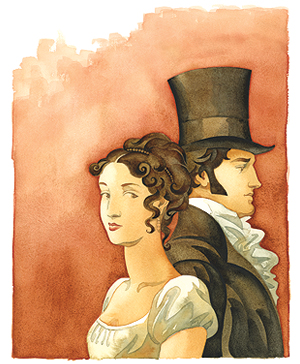
But what does the hook up culture and porn have to do with  Jane Austin’s Pride and Prejudice? Mark Mitchell ties it in right nicely.

Excerpt

Try, for instance, to imagine Elizabeth and Mr. Darcy (Lizzy and Fitz no doubt) hooking up. It is impossible. Given who they are and the value they place on propriety, constancy, amiability, and marriage, to imagine them participating in the hook-up culture is to debase them. It is to seriously damage their integrity as persons. How could it do anything less?

Excatly. Austin and her characters understood what our supposedly enlightened society refuses to face.  People are not objects to be used.

Do read the entire article here.

Posted in Sin, Theology of the Body, Uncategorized | Tagged , , | Leave a comment

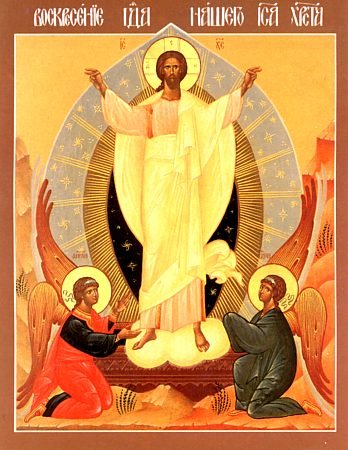
Christ is Risen! Alleluia!

Blessed Easter Season! 

Well I am exhausted and elated after the Easter Vigil.  It is such an honor to be a part of  the journey of those who enter into the Catholic Church.   I will never tire of seeing the joy of the newly baptized as they step out of the baptismal font and of the candidates for full Communion as they are Confirmed and receive the Eucharist for the first time.

The fast has ended. Let the feasting begin. The Church celebrates seven glorious weeks of feasting.

The RCIA is such a joy filled ministry.  People find Christ. People who are broken find healing.  Alleluia!

St. Augustine wrote that the Christian should be an Alleluia from head to toe. But what does it mean to be an Alleluia?

I think that I will let St. Augustine explain. Excerpt:

The season before Easter signifies the troubles in which we live here and now, while the time after Easter which we are celebrating at present signifies the happiness that will be ours in the future. What we commemorate before Easter is what we experience in this life; what we celebrate after Easter points to something we do not yet possess. This is why we keep the first season with fasting and prayer; but now the fast is over and we devote the present season to praise. Such is the meaning of the Alleluia we sing.
Both these periods are represented and demonstrated for us in Christ our head. The Lord’s passion depicts for us our present life of trial – shows how we must suffer and be afflicted and finally die. The Lord’s resurrection and glorification show us the life that will be given to us in the future.
Now therefore, brethren, we urge you to praise God. That is what we are all telling each other when we say Alleluia. You say to your neighbor, “Praise the Lord!” and he says the same to you. We are all urging one another to praise the Lord, and all thereby doing what each of us urges the other to do. But see that your praise comes from your whole being; in other words, see that you praise God not with your lips and voices alone, but with your minds, your lives and all your actions.

Read more here.

Posted in Easter Vigil, Liturgical Year | Tagged , , | 2 Comments

We Believe in Christ and Him Crucified

A few links for your Good Friday meditation.

1.  Over at First Things Peter J. Leithart  has a beautiful reflection on the Crucifixion.

Excerpt:

“The cross is the work of the Father, who gave His Son in love for the world; the cross is the work of the Son, who did not cling to equality with God but gave Himself to shameful death; the cross is the work of the Spirit, through whom the Son offers Himself to the Father and who is poured out from the pierced side of the glorified Son. The cross displays the height and the depth and the breadth of eternal Triune love.

The cross is the light of the world; on the cross Jesus is the firmament, mediating between heaven and earth; the cross is the first of the fruit-bearing trees, and on the cross Jesus shines as the bright morning star; on the cross Jesus is sweet incense arising to heaven, and He dies on the cross as True Man to bring the Sabbath rest of God.

Adam fell at a tree, and by a tree he was saved. At a tree Eve was seduced, and through a tree the bride was restored to her husband. At a tree, Satan defeated Adam; on a tree Jesus destroyed the works of the devil. At a tree man died, but by Jesus’ death we live. At a tree God cursed, and through a tree that curse gave way to blessing. God exiled Adam from the tree of life; on a tree the Last Adam endured exile so that we might inherit the earth.

The cross is the tree of knowledge, the tree of judgment, the site of the judgment of this world. The cross is the tree of life, whose cuttings planted along the river of the new Jerusalem produce monthly fruit and leaves for the healing of the nations.

The cross is the wooden ark of Noah, the refuge for all the creatures of the earth, the guarantee of a new covenant of peace and the restoration of Adam. The cross is the ark that carries Jesus, the greater Noah, with all His house, through the deluge and baptism of death to the safety of a new creation.” Continue reading this beautiful reflection here.

2. The Vatican has The Way of The Cross with meditations from Sr. Maria Rita Piccione O.S.A.   The Pope read her meditations when he led the stations at the Colosseum.

Finally here is a video from the last nine minutes of The Passion of the Christ. H/T Deacon Greg.

Posted in Jesus Christ, Liturgical Year | Tagged , , | Leave a comment

God is Searching for Me. Do I want Him to find Me?

Pope Benedict gave a beautiful Homily at today’s Chrism Mass. H/T to Rocco  Palmer of  Whispers in the Loggia.

Excerpt:

In today’s liturgy, three oils are blessed, as I mentioned earlier. They express three essential dimensions of the Christian life on which we may now reflect. First, there is the oil of catechumens. This oil indicates a first way of being touched by Christ and by his Spirit – an inner touch, by which the Lord draws people close to himself. Through this first anointing, which takes place even prior to baptism, our gaze is turned towards people who are journeying towards Christ – people who are searching for faith, searching for God

The oil of catechumens tells us that it is not only we who seek God: God himself is searching for us. The fact that he himself was made man and came down into the depths of human existence, even into the darkness of death, shows us how much God loves his creature, man. Driven by love, God has set out towards us. “Seeking me, you sat down weary … let such labour not be in vain!”, we pray in the Dies Irae. God is searching for me. Do I want to recognize him? Do I want to be known by him, found by him? God loves us. He comes to meet the unrest of our hearts, the unrest of our questioning and seeking, with the unrest of his own heart, which leads him to accomplish the ultimate for us. That restlessness for God, that journeying towards him, so as to know and love him better, must not be extinguished in us. In this sense we should always remain catechumens. “Constantly seek his face”, says one of the Psalms (105:4). Saint Augustine comments as follows: God is so great as to surpass infinitely all our knowing and all our being. Knowledge of God is never exhausted. For all eternity, with ever increasing joy, we can always continue to seek him, so as to know him and love him more and more. “Our heart is restless until it rests in you”, said Saint Augustine at the beginning of his Confessions. Yes, man is restless, because whatever is finite is too little. But are we truly restless for him? Have we perhaps become resigned to his absence, do we not seek to be self-sufficient? Let us not allow our humanity to be diminished in this way! Let us remain constantly on a journey towards him, longing for him, always open to receive new knowledge and love!

Please read the whole homily over at Rocco’s place, “Do Not Allow Us to Become a ‘Non-People’! Make Us Recognize You Again!”

Here is a video of the Dies Irae. You can find the English translation of the words here (scroll down to text).

Posted in Liturgical Year, Pope Benedict XVI | Tagged , , | Leave a comment