The O Antiphons of Advent

Yesterday, December 17th, we began the great O Antiphons of Advent. It was also my
O Antiphons

son Sean’s, gulp, 37th birthday. I am definitely not old enough to have a son that old.

Here is the scoop  on the O Antiphons from The Crossroads Initiative.

“In the Church’s Liturgy of the Hours, Evening Prayer, also know as Vespers, always includes the great prayer of Mary known as the Magnificat. Each day, the Magnificat is preceded by a short verse or “antiphon” that links the prayer to the feast of the day or the season of the year.  In the last seven days of Advent (December 17-24), the antiphons before the Magnificat are very special.  Each begins with the exclamation “O” and ends with a plea for the Messiah to come. As Christmas approaches the cry becomes increasingly urgent.

These moving “O Antiphons” were apparently composed in the seventh or eighth century when monks put together texts from the Old Testament, particularly from the prophet Isaiah, which looked forward to the coming of our salvation. They form a rich, interlocking mosaic of scriptural images. The great “O Antiphons”  became very popular in the Middle Ages when it became traditional to ring the great bells of the church each evening as they were being sung.

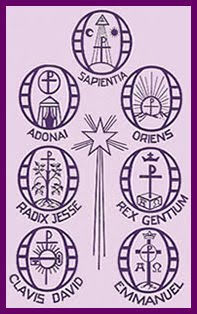
Each of the O Antiphons highlights a different title for the Messiah: O Sapientia (O Wisdom), O Adonai (O Lord), O Radix Jesse (O Root of Jesse), O Clavis David (O Key of David), O Oriens (O Rising Sun), O Rex Gentium (O King of the Nations), and O Emmanuel.  Also, each one refers to the prophecy of Isaiah of the coming of the Messiah.  A particularly fascinating feature of the O Antiphons is that the first letter of each invocation, when read backwards, forms an acrostic in Latin: the first letters of Sapientia, Adonai, Radix, Clavis, Oriens, Rex, and Emmanuel in reverse form the Latin words: ERO CRAS. These can be understood as the words of Christ, responding to his people’s plea, saying  “Tomorrow I will be there.”

The antiphon for yesterday and today:

December 17th:
O Sapientia (Is. 11:2-3; 28:29): “O Wisdom, you come forth from the mouth of the Most High. You fill the universe and hold all things together in a strong yet gentle manner. O come to teach us the way of truth.”

December 18th:
O Adonai (Is. 11:4-5; 33:22): “O Adonai and leader of Israel, you appeared to Moses in a burning bush and you gave him the Law on Sinai. O come and save us with your mighty power.”

O Adonai: “O sacred Lord of ancient Israel, who showed yourself to Moses in the burning bush, who gave him the holy law on Sinai mountain: come, stretch out your mighty hand to set us free.”

Isaiah had prophesied, “But He shall judge the poor with justice, and decide aright for the land’s afflicted. He shall strike the ruthless with the rod of his mouth, and with the breath of his lips he shall slay the wicked. Justice shall be the band around his waist, and faithfulness a belt upon his hips.” (11:4-5); and “Indeed the Lord will be there with us, majestic; yes the Lord our judge, the Lord our lawgiver, the Lord our king, he it is who will save us.” (33:22).


Posted in Liturgical Year | Tagged | 1 Comment

Ireland Forced To Make Abortion Legal

This is terrible and it goes against the will of the Irish people.

The Irish Times reports:Irish abortion laws breach human rights, court rules

“The European Court of Human Rights has ruled that Ireland has failed to properly implement the constitutional right to abortion where a woman is entitled to one where her life is at risk.

The ruling will put the issue of abortion back on the political agenda and is likely to force the Government to introduce legislation or official guidelines on access to abortion for women whose lives are at risk.

Minister for Health Mary Harney said the Government would reflect on the ruling and take legal advice.

Acknowledging the judgment was binding on the Irish State, she said the Government would have to come forward with proposals to reflect the ruling. “However, this will take time as it is a highly sensitive and complex area,” Ms Harney said.

The court unanimously ruled this morning that the rights of one of three women who took a case challenging Irish abortion laws were breached because she had no “effective or accessible procedure” to establish her right to a lawful abortion.”

Get the whole article here.

Please pray that the Irish people put pressure on the government to not cede their autonomy to the EU. It would be far better for them to pull out of the EU than to be forced to allow evil.

I don’t know who Kathy Ireland is, but she gives a great argument against abortion

Posted in Abortion | Tagged , , | 1 Comment

Make Straight The Path

I ask God, everyday, to increase my heart so that I will be able to love more.  Elizabeth Scalia, aka The Anchoress has a reflection on what real love means.

Exerpt:

“Obstacles are the things we cling to so much, out of love, that they take up the room He requires to bring the fullness of His divine, pure and unfathomable Presence into us.

We must love. Love is a good thing. But there must be just enough detachment in our love as to let God move within us, freely and unimpeded, forward to our very core. He will use every inch of our hearts, every inch of our minds, every inch of our souls; His Majesty will expand them and enlarge them as He wills–and always to our benefit–if only we will first give Him some room.

And then, when our beings are enlarged, and permeated with Him, our love for all things, including those which we hold most dear, will be all the sweeter to us–and that much deeper–but never in a manner the least idolatrous.

Make straight the path–clear away the brush of your heart–remove every obstacle, and he will come to dwell in you!” Read more here.

The trouble is that I keep detouring onto the dangerous curves instead of  sticking to the straight path. !

Posted in Discipleship, Holiness | Leave a comment

What If The Nativity Happened in the Digital Age?

This is very clever! H/T Deacon Greg over at his new digs.


Posted in Cool Stuff | Tagged , | 2 Comments

Saint of The Day

Today is the memorial of St. John of the Cross. (You can read about St. Lucy, yesterdays feast day here.)

“St. John of the Cross (1542-1591) was born and died in Spain. His parents were poor and could not give him training in any trade. Hence he became the servant of the sick in the hospital of Medina. In 1563 he offered himself as a lay brother to the Carmelite friars, who, however, perceiving his unusual talents, had him ordained a priest. When he was about to join the more severe Order of the Carthusians, the saintly Teresa persuaded him to remain and help her in the reform of the Carmelite Order. This reform of his order caused him such sufferings and brought him many trials. But his sufferings served only to detach him from creatures. He had a great devotion to Our Lord’s Passion and voluntarily sought out humiliations. When Our Lord asked him what reward he would ask for his labors, John answered: “To suffer and to be despised for Thee.” He died of a cruel disease, embracing the crucifix. Because of his profound treatises on mystical theology Pope Pius XI proclaimed him Doctor of the Church.” Read more about St. John of the Cross here.

Today’s Office of reading has an excerpt from A Spiritual Canticle by St. John of the Cross. Here is a sample:

“Would that men might come at last to see that it is quite impossible to reach the thicket of the riches and wisdom of God except by first entering the thicket of much suffering, in such a way that the soul finds there its consolation and desire. The soul that longs for divine wisdom chooses first, and in truth, to enter the thicket of the cross.

Saint Paul therefore urges the Ephesians not to grow weary in the midst of tribulations, but to be steadfast and rooted and grounded in love, so that they may know with all the saints the breadth, the length, the height and the depth – to know what is beyond knowledge, the love of Christ, so as to be filled with all the fullness of God.

The gate that gives entry into these riches of his wisdom is the cross; because it is a narrow gate, while many seek the joys that can be gained through it, it is given to few to desire to pass through it.”

Do read the whole reading.

Father Barron at the tomb of St. John of the Cross.


Posted in Saints | Leave a comment

Saint Of The Day: St. Damasus, Pope

“St. Damasus was Supreme Pontiff from 366 to 384. He was a very learned man, well versed in the Scriptures. He commissioned St. Jerome to complete the translation of the Bible into the Latin language. Shortly after his reign the 72 books of the Bible, hitherto scattered in different parts of the Orient, were collected into one volume. He defended the rights of the Holy See, and beautified the Roman resting places of the Christian dead and of the saints. He also confirmed the practice of singing the Psalms day and night in the churches and adding a Glory Be at the end of each Psalm.” More here.

Posted in Saints | Leave a comment

When The Saints Go Marching In

Pope decrees sainthood for Italian, beatification for 11 others

“Vatican City, Dec 10, 2010 / 12:26 pm (CNA/EWTN News).- The Holy See’s Press Office has announced the Pope’s decision to advance the sainthood causes for 16 Catholics.

Pope Benedict XVI met with the head of the Vatican office for the causes of saints, Cardinal Angelo Amato, on Dec. 10 to discuss canonization causes ready to pass on to the next stage.

A series of steps marks the road to sainthood. First, the cause is begun on a local, diocesan level at which time information is collected on the person known to have led an exemplary or “heroic” Christian life.

Information is collected at the local bishop’s request, resulting in a biography of the person, any writings they created, and testimonies from witnesses being sent to the Vatican’s Congregation for the Causes of Saints. After further investigation by a panel, those who advance are either recognized for their “heroic virtue” and declared “venerable” or declared martyrs for the faith, thus bypassing the venerable stage to be beatified and declared “blessed.”

“Venerables” to whose intercession a miracle is attributed advance by further papal decree to be beatified and declared “blessed.”

Once a person is declared “blessed,” the final step to canonization and recognition as a saint is the attribution of a second miracle for non-martyrs and a single miracle for those who suffered martyrdom.

These most recent decrees authorized by Pope Benedict XVI include a miracle attributed to the intercession of Blessed Guido Maria Conforti. Bishop Conforti of Parma, Italy died in 1931.

Oh yes. I want to be in that number!

Posted in Saints | Leave a comment

How Long O Lord?

I realize that my post on the call to rejoice always is often beyond difficult. You are not alone.

Posted in Humor | Leave a comment

The Third Sunday in Advent. Rejoice!

On Sunday we will be celebrating what is traditionally known as Gaudete Sunday. Guadete is Latin for rejoice.

Over at Patheos, Pat Gohn, has a post on the significance of the Third Sunday in Advent, The Pink Candle and Other Musings.

Excerpt:

This Third Sunday, the Church is harkening to its good news: the Word is made flesh in Jesus, and the Kingdom of Heaven is born in our midst.

The imagery in Sunday’s First Reading from Isaiah, recorded centuries before the first coming Christ, hints at this coming joy.

The desert and the parched land will exult; the steppe will rejoice and bloom.

They will bloom with abundant flowers, and rejoice with joyful song. The glory of Lebanon will be given to them, the splendor of Carmel and Sharon; they will see the glory of the LORD, the splendor of our God . . .

Here is your God, he comes with vindication; with divine recompense he comes to save you . . .

Those whom the LORD has ransomed will return and enter Zion singing, crowned with everlasting joy; they will meet with joy and gladness, sorrow and mourning will flee (Is. 35:1-2, 4, 10).

As always, there is much to meditate on, but the simple phrase that captures my attention as we come to this Sunday with joy is that once-and-future hope that the prophet gives about one day coming back to our true homeland, “crowned with everlasting glory.”

And I wonder if we could envision ourselves on that special Day, would we live any differently than we do now?

After all, rejoicing, as a verb, means it is something that we do.

Why? Because it is something that we Christians are: Joyful.

Or, are we still works in progress in the joy department?”

Me? Definitely a work in progress. I am a very unfinished Christian. But I do think that I am doing better in the joy department.

But the credit for my progress goes to the Holy Spirit. A few years ago, I was completely stressed out.  We had and have ongoing financial problems stemming from the year that my husband was out of work and his slow climb back up the managerial ranks.

Everything seemed to be going from bad to worse. Then one Sunday at Mass the words of the prayer after the Lord’s prayer hit me hard,

In your mercy keep us free from sin and protect us from all anxiety as we wait in joyful hope for the coming of our Savior, Jesus Christ.

That was my Eureka moment. An epiphany.

I realized then that the stress and anxiety that I was feeling were symptoms. They were symptoms that I was not really trusting God.

Real Christians trust God especially in the bad times. Real Christians reflect joy, because a real Christian knows that all things work for good for those who love God (Rom. 8:28).

As Christians we are called to witness. We are called to bear our suffering with joy and hope. There is no such thing as a fair weather Christian.

This often seems impossible. But we know in our hearts that it is possible. We have the Saints as our example; the great cloud of witnesses that have gone before us.

As Pat Gohn writes,

“Know anyone with complete joy? Those who come to mind, for me, are the saints.  The saints started with the same raw materials we did. Yet, we witness their joie de vivre even when imperiled by trial, illness, the devil, or death. Joy seems a natural byproduct of sanctity, a natural “fruit” of the Spirit (Gal. 5:22).   And its presence can even be impervious and independent of circumstances . . . Rejoice in the Lord always.”

H/T The Anchoress.

Posted in Discipleship, Holiness, Liturgical Year | 2 Comments

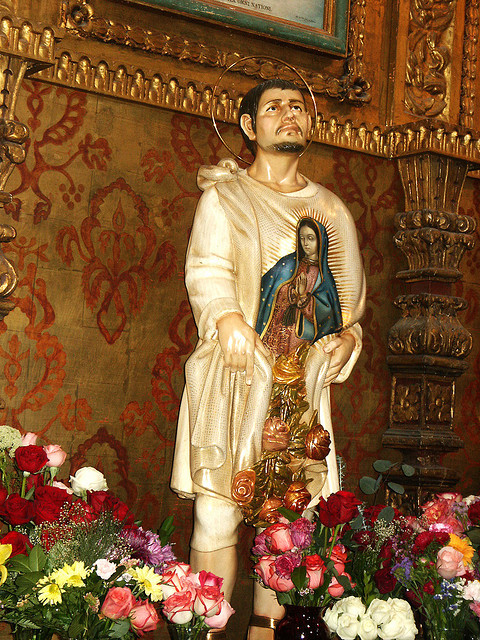
Saint Of The Day: St. Juan Diego

“Today the Church in the United States celebrates the optional memorial of St. Juan Diego, an Indian convert, to whom the Virgin Mary appeared as he was going to Mass in Tlatlelolco, Mexico. Our Lady asked him to tell the Bishop that she desired a shrine to be built on the spot to manifest her love for all mankind. She left a marvelous portrait of herself on the mantle of Juan Diego as a sign for the Bishop. This miraculous image has proved to be ageless, and is kept in the shrine built in her honor, the Basilica of Our Lady of Guadalupe, Patroness of the Americas.”

Read more about St. Juan Diego here.

Prayer:

Collect: Lord God, through St. Juan Diego you made known the love of Our Lady of Guadalupe toward your people. Grant by his intercession that we who follow the counsel of Mary, our Mother, may strive continually to do your will. We ask this through our Lord Jesus Christ, your Son, who lives and reigns with you and the Holy Spirit, one God, for ever and ever. Amen.

Posted in Saints | Leave a comment