Pro Life Mass And Prayer Vigil

Readers who live in the Des Moines area, you are invited and encouraged to come to the Pro Life Mass tonight and a prayerful vigil outside Planned Parenthood on Saturday.

Catholic Charities Social Justice Consortium of the Diocese of Des Moines invites
the public to attend the annual Mass for Life on Friday, January 21, 2011 at St.
Pius X Church, 3601 66th St. in Urbandale.

The annual Mass for Life promotes the Church’s belief of the sanctity of life and
dignity of the human person from conception to natural death.

The evening will feature a pre-Mass performance of excerpts from the upcoming musical,  “The Pope of the People,” adapted by Tom Quiner. The performance will begin at 6:00  p.m. followed by Mass at 6:30 p.m. with Bishop Richard Pates presiding. A reception will immediately follow Mass.

And:

Before I formed you in the womb, I knew you -Jer. 1:5
Prayerful Protest of Planned Parenthood on Army Post Rd across from Southridge Mall 2pm tomorrow Saturday Jan. 22 (Anniversary of Roe v. Wade) -dress warm!

Let us all pray for the end of abortion!

Posted in Pro life | Tagged | Leave a comment

Saint of the Day: St. Agnes, Virgin and Martyr

This brave Saint was only 12 when she died for the faith.

“St. Agnes (c. 304) like St. Cecilia, is to be numbered among the most famous martyrs of Rome. When the Diocletian persecution was at its height, and when priests as well as laymen were apostatizing from the faith, Agnes, a girl of twelve, freely chose to die for Christ. When she was commanded to offer incense to false gods, she raised her hand to Christ and made the Sign of the Cross. When the heathens threatened to bind her hand and foot, she herself hastened to the place of torture as a bride to her wedding feast. Pain had no terror for her—although the fetters slipped from her small hands while even the pagan bystanders were moved to tears.

When the son of the Roman prefect offered to marry her, she replied: “The one to whom I am betrothed is Christ Whom the angels serve.” When the executioner, who was to behead her, hesitated, she encouraged him with the words: “Strike, without fear, for the bride does her Spouse an injury if she makes Him wait”. The name of “Agnes” means “lamb-life,” and hence the lamb is the symbol of the modesty and innocence of the virgin-martyr.” Read more at Catholic Culture.

Mike Aquilina over at The Way of  the Fathers, notes that:

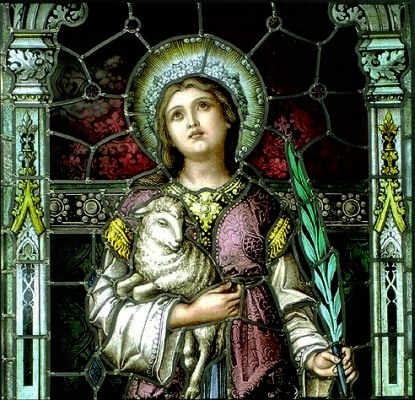
Today’s saint, Agnes of Rome, is long overdue for a revival. Why? She was probably the most revered female martyr of the early Church — outstanding in a field that included Blandina and Perpetua, among others. St. Jerome was not a man easily impressed, but of today’s saint, his near-contemporary, he wrote: “Every people, whatever their tongue, praise the name of Saint Agnes.” Prudentius wrote a long poem and a hymn in her honor. Ambrose extolled her as the model virgin. Augustine praised her. Damasus memorialized her in verse. Her name means lamb, and in art she often appears holding a lamb.  Read more here.

The awesome Fr. Z , What Does the Prayer really say? has some fascinating information.  Get thou there!

Posted in Saints | Leave a comment

Sex and the Married Deacon

Ok, I am now going into territory that more angelic deacon wives might fear to   tread.  For several days the Catholic blogs have  been heating up on the question, “ are married deacons obligated under Canon Law to observe continence” (abstaining from sex). Of course this would mean that deacons wives would, by default, have to abstain.

For the record, I tried to stay out of the discussion. Really. But it will not die. And I do have a horse in the race.

It all began with a paper by Canonist Dr. Ed Peters http://www.canonlaw.info/a_deacons.htm. Dr. Peters, who I respect and admire, asserts that married deacons are required under cannon law to be continent. Huh!

My Jaw is still super glued to the floor.

But I respectfully think that he is wrong. It is my humble opinion that he is looking through a very narrow canon law lens.  That said, let me be clear: if Dr. Peters is correct and the Church issues a clarification deacon and I will, of course, be obedient.

Thankfully, I am not alone. Here is a taste.

Deacon Greg Kandra is aghast:

Well, now.  Does anyone seriously think that tens of thousands of married deacons — not to mention the hundreds of married priests — are now suddenly going to commit to stop having sex with their wives?  Does anyone think the vocation could even survive such a 180 degree turnaround? 

Well yes if the Holy Spirit wills it.

Deacon William T. Ditewig, who has a Ph.D in theology from the Catholic University of America weighs in  you can read his arguments here. His conclusion is, therefore, that the mind of the church is such that there is NO expectation of clerical continence by married deacons, despite Dr. Peters’ claims.  Perhaps Dr. Peters is correct that the law should be changed to prevent any similar misunderstanding in the future.

There are many more priests and deacons who have weighed in on the subject, but I am not going to link to them all. Some have taken Dr. Peters position, but his is the most compelling. His latest contribution may be found here.

Okay. So even though I am the peasant in the room, I am going to weigh in. Being out classed has never stopped me before.

The Code of Cannon Law (CCL) is not, as I understand it, always the final say on Church teaching and disciplines.

The consistent Liturgy of the Church, the consistent practice of the Church, and relevant Church documents must also be considered.

First let us consider the Rite of Ordination to the deaconate. In the rite, unmarried men promise to remain celibate.  If married deacons are to practice continence, why is such a promise not included in the rite for married men?

Second let us consider the combined documents BASIC NORMS FOR THE FORMATION OF PERMANENT DEACONS DIRECTORY FOR THE MINISTRY AND LIFE  OF PERMANENT DEACONS

The document, Basic Norms for the Formation of Permanent Deacons states:

…. For married candidates, to live love means offering themselves to their spouses in a reciprocal belonging, in a total, faithful and indissoluble union, in the likeness of Christ’s love for his Church; at the same time it means welcoming children, loving them, educating them and showing forth to the whole Church and society the communion of the family…..(#68)

This suggests that married deacons are not required to abstain. At least I don’t think that the passage is saying, in effect, hurry up and have children while you are in formation, because once you are ordained it will not be possible!

The second document, Directory for the Ministry and Life of Permanent Deacons is clear:

“The Sacrament of Matrimony sanctifies conjugal love and constitutes it a sign of the love with which Christ gives himself to the Church (cf. Eph. 5:25). It is a gift from God and should be a source of nourishment for the spiritual life of those deacons who are married.” (#61)

In other words the physical union of husband and wife is integral to the life of the married deacon (and all married persons).

Third, in the early Church, married men were ordained to the deaconate. There is no evidence, no record that they practiced continence.

Finally requiring continence within marriage corrupts marriage and virginity:

Whoever denigrates marriage also diminishes the glory of virginity. Whoever praises it makes virginity more admirable and resplendent. What appears good only in comparison with evil would not be truly good. The most excellent good is something even better than what is admitted to be good. (CCC 1620).

Yes. I do think that requiring continence from married deacons degrades the Sacrament of Marriage. It also diminishes the great sacrifice that celibate clerics offer up for the kingdom

It turns marriage into something that it is not. Sacramental Marriage is unitive and fruitful (along with indissoluble). It is through chastity and the marital act that unity is fully realized. And of course, unless you are the Virgin Mary, continence precludes fruitfulness.

Okay, for older deacon wives fruitfulness is moot. But it applies to younger deacons and their wives.

The CCC states, 1643 “Conjugal love involves a totality, in which all the elements of the person enter – appeal of the body and instinct, power of feeling and affectivity, aspiration of the spirit and of will. It aims at a deeply personal unity, a unity that, beyond union in one flesh, leads to forming one heart and soul; it demands indissolubility and faithfulness in definitive mutual giving; and it is open to fertility. In a word it is a question of the normal characteristics of all natural conjugal love, but with a new significance which not only purifies and strengthens them, but raises them to the extent of making them the expression of specifically Christian values.

Okay getting off my soap box now.  Besides I may be wrong, but I think that this is just a case of Canon Law not being in sink with the actual mind of the Church. It should be clarified so that we don’t indulge in making mountains out of ant hills.
Posted in Deaconate | Tagged | 18 Comments

Will the Tuscon Shooting Outlaw Metaphors?

It seems to much of the media metaphors are deadly triggers. Oops perhaps I             shouldn’t have used deadly or trigger.  Pat Archbold has a tongue in cheek post up at the National Catholic Register, Incendiary Stupidity or Killing Incivility.

He begins:

The following has been redacted for your own safety.

The other day I was killing time at Target. I overheard two guys shooting the breeze about the new civility. You know, the words and phrases we are no longer allowed to say because it might trigger a crazy person to do something, well crazy.

Heh. Do give it a read.

Posted in Humor | Tagged | Leave a comment

The Perpetual Virginity of Mary

Jimmy Akin has a video up: How did the Church Fathers explain the perpetual virginity of Mary.

Enjoy!

Posted in Apologetics, Early Church | Tagged | Leave a comment

Saint of the Day: St. Fabian, Pope and St. Sebastian

We have a twofer today as we celebrate these brave men who were martyred.

St. Fabian, Pope; St. Sebastian

The martyrs of the Church are a constant reminder that we are but pilgrims on this earth. Our true home is the kingdom of God. The early Christians knew that persevering in faith could earn them an often gruesome horrific death. Yet they had their eyes firmly fixed on heaven, because they knew that if they persevered in holiness they would receive a crown of glory for all eternity. Christian martyrs throughout the ages knew where their real home is and that no earthly prize can come close to matching that heavenly crown of glory.

In today’s Office of Reading for St. Sebastian,  St. Ambrose speaks about another kind of martyrdom that does result in death. This is often referred to as white martyrdom.  St. Ambrose reminds us that to be a Christian entails suffering and persecution:

Of this kind of persecution Scripture says: All who wish to live a holy life in Christ Jesus suffer persecution. All suffer persecution; there is no exception. Who can claim exemption if the Lord himself endured the testing of persecution?  How many there are today who are secret martyrs for Christ, giving testimony to Jesus as Lord! The Apostle knew this kind of martyrdom, this faithful witnessing to Christ; he said: This is our boast the testimony of our conscience.

To learn more about these great heroes of the faith, head over to Catholic Culture. Well I learned something new. St. Sebastian is always depicted tied to a tree while he is being executed by arrows. So he died by arrows right?  No. He survived the attempt, only to be beaten to death on the orders of the emperor. Who knew?

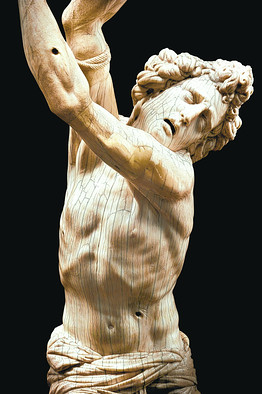
The Wall Street Journal, recently reported on a rediscovered sculpture of  St. Sebastian, An Ivory Carving of St. Sebastian Resurfaces (FYI: I have a subscription to the WSJ, so the article may be behind a firewall).

Excerpt:

After several centuries out of the public eye, an ivory carving of Saint Sebastian that’s impressed experts with its emotional power and large scale is about to make a reappearance. The scholar-dealer offering the work, created around 1638 by an obscure Germanic artist, is asking $4.75 million.

Here is a picture of the carving:

Posted in Liturgical Year, Saints | Tagged | Leave a comment

Govern with Faith and Reason

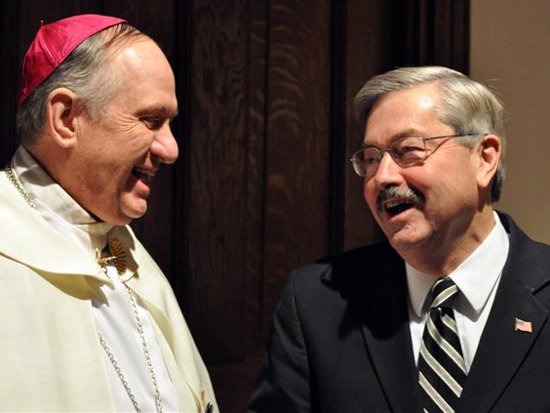
Our pastor, Msgr. Bognanno, gave the homily at the interfaith Inaugural Service of Dedication, for our new Governor, who is a Catholic. My husband was in attendance and he thought it was excellent.

excerpt:

Great leadership requires great wisdom.  In the Hebrew Scriptures, Solomon is the icon of wisdom.. As a youth of 16, he asked God for wisdom, realizing, as Israel’s new king, the enormity of the task at hand. Wisdom combines two of God’s gifts, namely reason and faith. To address the challenges facing Israel, Solomon skillfully combined both reason and Faith.

The word reason, when applied to politics, is classically defined as the “art of the possible”.    That is, doing what is possible to solve a problem.  but there may be many solutions to a problem and our political leaders, seek the “best solution”.   However, it is the gift of faith that directs the reasoning process to that “best solution”.

Do read the homily here.

A picture, from the service, of Bishop Pates and Governor Branstad:


Posted in Church and the Public Square | Leave a comment

“Vatican Warned Bishops not to Report Child Abuse” UPDATED

UPDATE: Scroll to the end.

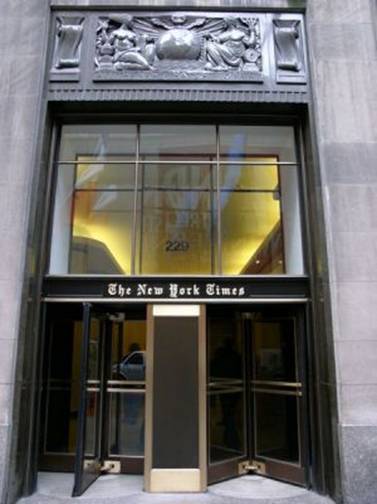
The Grey Lady is at it again. Breathlessly distorting the facts. But apologist extraordinaire, Jimmy Akin in his National Catholic Register article, Vatican warned Bishops not to Report Child Abuse, has the truth.

That’s the sensationalistic headline of this story in the New York Times. As usual, it’s by Laurie Goodstein, and as usual she makes significant errors in her reporting that make the story more sensationalistic in a way that (just coincidentally) paints the Holy See in an unfavorable light. (So . . . what’s up with that, Laurie? You’ve been on the beat long enough that you should be better informed on these matters.)

As with previous stories of the same nature, this one involves a document from back in the 1990s that has now come to the attention of the press. It was a letter written by the Apostolic Nuncio of Ireland (that’s basically the Holy See’s ambassador to Ireland, though he also has a liaising role with the local bishops). In the letter the Nuncio—then Luciano Storero—communicated a message to the Irish bishops from the Congregation for Clergy concerning a document that the Irish bishops had drafted on child sexual abuse.

This letter was immediately hailed by groups like SNAP as the “smoking gun” they’ve been waiting for, showing that the Holy See took part in the cover up of sexual abuse, allowing it to be sued in court, humiliated, and have money extracted from it.

You can read (a tiny, low resolution image of) the letter itself here.

Now let’s walk through it and see how the claims made about it stack up against the document itself . . .

Well what are you waiting for?  Get thou there and start walking!

The Church must be doing something right to merit such creative “journalism”.

UPDATE: I must give credit when it is due. Well. Hell just froze over yet again.  Mollie over at Get Religion, has a great post, A Vatican Smoking Gun on the original NYT report. But she found that the online version of the NYT has made some corrections. The NYT headline is now Vatican Warned Bishops on Abuse policy. It is, indeed, an improvement.

Posted in Catholic Church Scandals, Media | Tagged , | 1 Comment

The Most Powerful Prayer in the World

Prayer is often difficult. In the fourth pillar of the Catechism, Christian prayer, there  is an article on the Battle of Prayer (#2725-2745). We know that to have a relationship with God we must pray. We must pour out our hearts to our loving Father. We should try to listen for his small still voice.

But we object that we don’t have time. We think that our prayers are unproductive because we do not understand that prayer originates and flows from the Holy Spirit. Prayer is not something that we can do all by ourselves. Everyday life distracts us when we attempt to pray.

God does not always give us what we want. But He always gives us what we truly need. But because we do not see “what’s in it for me”, we determine that it is a useless endeavor.

But prayer has the power to change us. To transform us.

Perhaps we need to retrench and stop making prayer so difficult. There is an ancient prayer that is quite simple. But it is also very powerful.  Peter Kreeft has an excellent article on this prayer, The Jesus Prayer:

It is called the “Jesus Prayer”, and it consists simply in uttering the single word “Jesus” (or “Lord Jesus”, or “Lord Jesus Christ, have mercy on me, a sinner”) in any situation, at any time and place, either aloud or silently.

There is only one prerequisite, one presupposition: that you are a Christian. If you have faith in Christ, hope in Christ, and love of Christ, you can pray the most powerful prayer in the world, because you have real contact with the greatest power in the universe: Christ himself, who assured us, in his last words to his apostles, that “All authority in heaven and on earth has been given to me” (Mt 28:18).

It is also the simplest of all prayers. It is not one of the many “methods”, because it bypasses methods and cuts right to the heart of practicing God’s presence, which is the essence of prayer, the secret of which has been given to us by God the Father. The secret is simply God the Son, God incarnate, the Lord Jesus.

1. Its simplicity and flexibility

As the Catechism says, “The invocation of the holy name of Jesus is the simplest way of praying always…. This prayer is possible ‘at all times’ because it is not one occupation among others but the only occupation: that of loving God, which animates and transfigures every action in Christ Jesus” (CCC 2668).

Read the whole enchilada here.  Pray always by invoking the name of Jesus the Lord, Lord Jesus have mercy on me a sinner.

Posted in Prayer | Tagged , | 6 Comments

A Protestant Discovers Sign of the Cross

And a few other items. I am really busy this weekend, and I am behind due to MS–mostly fatigue.

I had always thought that making the sign of the cross was mainly a Catholic practice. But it seems that  some Protestants that it is a powerful sacramental and not a superstitious act. Blogger Joe Miller in an interesting post, Bless Yourself (with the sign of the Cross), has some interesting observations.

Excerpt:

Growing up, I always understood the sign of the cross to be empty superstition. I am grateful to have learned otherwise since then and use it many times a day in prayer. (I talk about some of the reasons why here.) My old understanding has, however, left me prejudiced—I assume that evangelicals do not use it, let alone prescribe its use to others.

But then there’s Bonhoeffer, taking comfort in signing himself while imprisoned and Luther instructing every Lutheran since his own day to “bless yourself with the holy cross,” as he says in his Small Catechism. Luther actually instructed its use on other occasions as well, not only for morning and evening prayer, but also for baptism and ordination. Read the whole post here.

Did you know that the federal government is determining what Catholic Colleges are, in fact, Catholic and not CINO  (Catholic in name only)? Monsignor Pope has the scope in his post Catholic or Consequences: Feds increasingly tell Catholic Entities to Be Authentically Catholic or Lose Religious Exemptions.

It is a fairly detailed examination of the situation. While it is true that too many Catholic Colleges are CINO, it should be the Bishops and not the government should be the ones to make the determination.

Excerpt

It shouldn’t take Pharaoh to tell Abram to go back to Bethel. It shouldn’t  take pagan sailors to rouse Jonah to obey God. And it shouldn’t take the Federal Government to tell Catholic Colleges to actually be Catholic. But if that’s what it takes, if God has to shame them  into it, so be it . God has a history of drawing Israel to repentance by making use of the nations around them to provoke, shame, and punish them. As Scripture says,

The LORD’s portion is his people, Jacob his allotted inheritance….[Yet] you deserted the Rock, who fathered you; you forgot the God who gave you birth….[The Lord says], for they are a perverse generation, children who are unfaithful. They made me jealous by what is no god and angered me with their worthless idols. [So] I will make them envious by those who are not a people; I will make them angry by a nation that has no understanding. (Deut 32: varia)

Read the whole post here.

Over ten years ago I was attending an RCIA workshop. During one of the breaks, several of the participants were complaining about the fact that their diocese were closing Parishes. I pointed out that one of the reasons that parishes were being consolidated was because of the shortage of Priests.

Most of the workshop attendees were around my age. I mentioned that the reason is that too many Catholic parents do not encourage vocations or ask their child if they might have one.  In other words, the problem is us.  I was not very popular from there on out.

Robert Miola, has a moving post about his reaction to two of his daughters vocations:

I tried to reason with her: “You are going into a Servants of the Lord novitiate, and that is by definition a time to try things out, to discern. Take it easy and see if it is right for you.” “No,” she told me firmly, “I love passionately and want to give everything now—no holding back.”

“You should use the talents God gave you and the education I paid for,” I respond, all but oblivious to the folly of that coordination. “You can work in a soup kitchen and feed twenty or you can write food-stamp legislation and feed twenty thousand.” She shakes her head and looks at me with amusement and, perhaps, a touch of pity.

Read it all at First Things. But grab some tissues first. H/T The Anchoress

Posted in Catholic, Religious Orders, Uncategorized, Vocations | Leave a comment