Eternal Life Without God?

Fr. Barron saw the movie “Hereafter”. He liked it but, he is puzzled that the movie detaches life after death from God. Can’t do that. H/T Aggie Catholics

Posted in Movies | Tagged , | Leave a comment

Vote For The True, The Free, The Good

I wish that I had found this article by Deacon Fournier earlier.  He clearly states how Catholics should engage their faith and reason at the polls. It is longish, but worth the read especially if you haven’t voted yet.

Excerpt

As we exercise our civic duty on November 2, 2010, I share some principles on a Catholic vision of governance.  Our identity as Catholics grounds us in a vision of the human person, human flourishing, marriage (and the family and society founded upon it), the Natural Law as the reference point for all positive law, authentic human freedom, and the existence of objective morality. This vision is not simply “religious”. Rather it provides a framework for our work as citizens to serve the common good. It calls us to build what Pope Benedict XVI recently called a “culture of the person”.

It begins by insisting that the civil government recognize the dignity of every human person from conception until natural death. This is the polestar for our political participation. Those who seek to marginalize us refer to this as being “single issue” politics. In fact, it is not about an “issue” at all. It provides what philosophers and theologians call a “hermeneutic”, a lens, a framework through which every issue must  be evaluated. Without the Right to Life there are no other rights. After all, human rights are goods of the person, given to us by the Creator. When there is no person there can be no rights to be received or exercised.

Think about it. Even economic issues begin with the recognition of the dignity of every human person. This election presents some very serious concerns regarding the state of the American economy. The reason we should want to see economic opportunity expand is because we want every person to be able to participate and be rewarded for initiative and hard work in order to flourish and be truly free. The reason we should be concerned about the poor is because we recognize their human dignity. The reason we should be worried about the expansion of the federal government is because collectivism, of any kind, is a threat to human dignity and human freedom and flourishing.

Excerpt

Our insistence on the recognition of the Right to Life is not based solely upon our belief in Revelation, though it is found at the heart of both Sacred Scripture and the living Tradition of the Church. It is written on every human heart through the Natural law and it is knowable by reason. We need to explain this if we hope to overcome the effort to marginalize our position as being based on “religious convictions” – a shorthand way of saying that it should be confined to the sphere of private beliefs. This is the bad fruit of the Dictatorship of Relativism. When there are no truths, there can be no real rights.

One of those truths is that marriage is a lifelong union between one man and one woman open to life, constituted for the good of the spouses, the good of children and the common good of society. Marriage is not our idea. It is revealed by the Natural Law and has been recognized as such cross culturally. Marriage and the family founded upon it is the first church, the first school, the first economy, the first hospital, the first government, the first society and the first mediating institution of any just social order. We must learn to discuss the goods of marriage and its proper ends in a language which communicates to an age deluded by ideologies of self centeredness.

Then, there is a true vision of human freedom. In the words of the late John Paul II, “Freedom itself needs to be set free”. We suffer from the aftermath of a counterfeit notion of freedom as a perceived “right” to do whatever one pleases. That is, again in the words of John Paul, “a counterfeit notion of freedom”. We must explain the truth that freedom brings with it an obligation to choose in accordance with what is right and true and good. Further, that only in choosing the good can men or women – or the societies which they form – ever hope to be good and be well.

Excerpt:

It is time to insist that there is an objective moral code which can be known through the exercise of reason. Further that it must order our life together if we want to be a truly civilized people. This view of the existence of such an objective moral code is the foundation of the American experiment in self governance. Only a recovery of the Western vision of a free society, derived from the treasury of the Church, can stem the slide toward materialism, nihilism and the self idolatry which is rotting our social order. We need to contend for the hearts and minds of our fellow citizens by explaining that we are, by nature and grace, made for the other and that only in the giving away of ourselves to the other will we ever find the human fulfillment and flourishing which we all long for.

Finally, we should reject anti-government rhetoric which sees governance in a Hobbesian view as a restriction on “freedom”. God governs the universe. We are called to participate in His governance. The real question that should be asked is how we govern and who does the governing. We need a vision of “good governance”. Good governance must be moral, recognizing and adhering to the good. It must also be “good” in the sense of being efficient and not violating the principle of subsidiarity. Subsidiarity is a social ordering principle which recognizes that government is good when it is closest to those being governed. Government begins in the family, the first government, and proceeds out to the local community and the mediating institutions of society.

It is time for US Catholics to Vote and then get on with the work of building a truly free and good society.

Posted in Church and the Public Square | Tagged , | Leave a comment

Love Is Stronger Than Death:All Souls Day

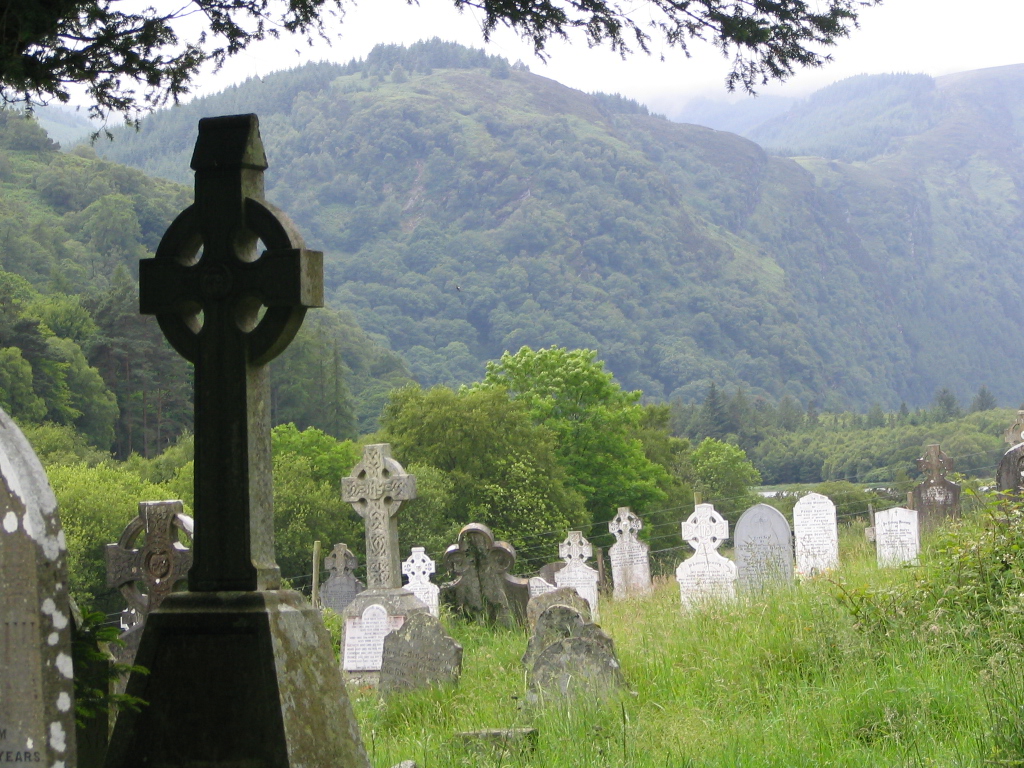
Today we remember all of our faithfully departed. It is a time to pray for the souls being purified in Purgatory.  Yes the Catholic Church still teaches that souls who die as friends of Christ but not quite holy enough for heaven go through a state of purgation.

Unfortunately, too many Christians, Catholics included, have lost the concept of sin. They seem to think that Jesus did all the work of salvation so the faithful will just go straight to heaven even if they fall far short of the glory of God.

But many of us die as unfinished Christians. We are not quite ready for prime time heaven. I know that I have a lot of  transforming to do. I am a poor Christian indeed. But God’s mercy is great. Purgatory is a great mercy. Deacon Larry, though, keeps telling me to stop shooting for Purgatory. I might miss.

Marcellino D’Ambrosio has a nice article on All Souls.

Excerpt:

“These days remind us that love is stronger than death, that Christ’s death for us means that our beloved deceased who believed in Christ are very much alive.  They may be among those whose lungs breathe the exhilarating air of heaven and whose eyes gaze upon the glory of God.   In this case, they help us through their prayers.

Yet they may also be among those whose lungs were not ready for breathing and whose eyes were not ready for the brilliance of the beatific vision, whose body carried an infection that needed to be eliminated.  In which case, we must help them through our prayers.  Our loving intercession can hasten the purification and preparation necessary for the full enjoyment of their inheritance.”

Read the whole article here. In the Office of Reading for today, St. Ambrose tells us that death is gain. Read all about it here.

Posted in Four Last Things | Tagged , | Leave a comment

Catholics And The Elections

Tomorrow we head to the polls to vote. As Catholic Christians we have a moral duty to vote.

There are certain things that the Church asks of us as we exercise our civic and moral duty.

First we need to have a well formed conscience. Emphasis on well formed conscience. Conscience is not just a feeling, belief, ideology, or gut reaction.

“We Catholics have a lifelong obligation to form our consciences in accord with human reason,enlightened by the teaching of Christ as it comes to us through the Church.” ( USCCB Summary Faithful Citizenship).

A well formed conscience, therefore, is formed by Christ through Holy Scripture and Holy Tradition as interpreted by the Magisterium of the Church.

Faithful Catholics cannot plead ignorance.

While it is true that Catholics should not be single issue voters, it is also true that we can never vote for intrinsic evils or a candidate that supports an evil.

An intrinsic evil is something that is always and everywhere morally wrong even if a good end would result. The ends can NEVER justifies the means.

In our culture of death, therefore, the pro life issues are paramount. Abortion, euthanasia, cloning. Embryonic stem cell research are always evil. They can never be justified. In addition,

“Other assaults on human life and dignity, such as genocide, torture, racism, and the targeting of noncombatants in acts of terror or war, can never be justified. Disrespect for any human life diminishes respect for all human life.” (USCCB Summary on Faithful Citizenship).

The fact is without the right to life from conception to natural death, human beings do not have rights. The right to life is foundational.

That is why the US Bishops state,

“As Catholics we are not single-issue voters. A candidate’s position on a single issue is not sufficient to guarantee a voter’s support. Yet a candidate’s position on a single issue that involves an intrinsic evil, such as support for legal abortion or the promotion of racism, may legitimately lead a voter to disqualify a candidate from receiving support.”

Catholics are also called to develop the virtue of prudence. The Catechism states:

“1806 Prudence is the virtue that disposes practical reason to discern our true good in every circumstance and to choose the right means of achieving it; “the prudent man looks where he is going.” 65 “Keep sane and sober for your prayers.” 66 Prudence is “right reason in action,” writes St. Thomas Aquinas, following Aristotle. 67 It is not to be confused with timidity or fear, nor with duplicity or dissimulation. It is called auriga virtutum (the charioteer of the virtues); it guides the other virtues by setting rule and measure. It is prudence that immediately guides the judgment of conscience. The prudent man determines and directs his conduct in accordance with this judgment. With the help of this virtue we apply moral principles to particular cases without error and overcome doubts about the good to achieve and the evil to avoid.”

Catholics may not cooperate with intrinsic evil. So what is a Catholic to do when all of the candidates are anti life? Good question.

One option is to not vote for those candidates (Faithful Citizenship #36). We may only vote for an anti life candidate for grave moral reasons. Perhaps, for example, one candidate will do less harm. Contrary to anti catholic rhetoric, the Church does not spell out exactly what this means. We are expected to do our homework.

The important thing to remember is that all human beings are made in the image and likeness of God. All human beings are sacred, unique, unrepeatable, and have intrinsic value.

People are more important than things, or income, or success.  This is true apart from the so called “quality of life”.

Catholics, then may never vote their pocket book.  We should always be Catholics first and not put loyalty to a particular party over the Church’s moral teaching. People come first. Period.

Oh. I almost forgot. The most important part our our discernment process is to pray that we are guided by the Holy Spirit.

Posted in Church and the Public Square | Tagged , , | Leave a comment

Solemnity of All Saints

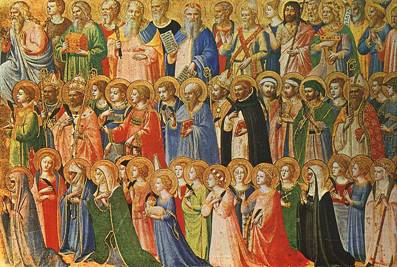
Today we celebrate the Church Triumphant. The Church Triumphant is all of the citizens of the heavenly city: the Saints who persevered in faith and won the battle against sin while on earth. The saints do not need a day to be honored.

We celebrate All Saints day as a sign of hope for the faithful on earth who are still engaged in the battle. We are the Church militant trudging through the swamps and deserts of this earthly life striving to win the battle and become holy.

Tomorrow, All Souls, we will remember all of the faithfully departed which includes the souls in purgatory. The souls in purgatory are those souls who fought the good fight and persevered until the end. But they were wounded in battle and are now in heavens hospital until they are ready for the glory of  heaven. They are the Church Suffering.

Today’s solemnity gives us hope that, if we turn to the Lord and strive for holiness, we too can become saints.

But Pope Benedict, in a homily from All Saints in 2006, says it much better than I can.

Excerpt:

“This, then, is the meaning of today’s Solemnity: looking at the shining example of the Saints to reawaken within us the great longing to be like them; happy to live near God, in his light, in the great family of God’s friends. Being a Saint means living close to God, to live in his family. And this is the vocation of us all, vigorously reaffirmed by the Second Vatican Council and solemnly proposed today for our attention.

But how can we become holy, friends of God? We can first give a negative answer to this question: to be a Saint requires neither extraordinary actions or works nor the possession of exceptional charisms. Then comes the positive reply: it is necessary first of all to listen to Jesus and then to follow him without losing heart when faced by difficulties. “If anyone serves me”, he warns us, “he must follow me; and where I am, there shall my servant be also; if any one serves me, the Father will honour him” (Jn 12: 26).

Like the grain of wheat buried in the earth, those who trust him and love him sincerely accept dying to themselves. Indeed, he knows that whoever seeks to keep his life for himself loses it, and whoever gives himself, loses himself, and in this very way finds life (cf. Jn 12: 24-25).

The Church’s experience shows that every form of holiness, even if it follows different paths, always passes through the Way of the Cross, the way of self-denial. The Saints’ biographies describe men and women who, docile to the divine plan, sometimes faced unspeakable trials and suffering, persecution and martyrdom. They persevered in their commitment: “they… have come out of the great tribulation”, one reads in Revelation, “they have washed their robes and made them white in the blood of the Lamb” (Rv 7: 14). Their names are written in the book of life (cf. Rv 20: 12) and Heaven is their eternal dwelling-place.

The example of the Saints encourages us to follow in their same footsteps and to experience the joy of those who trust in God, for the one true cause of sorrow and unhappiness for men and women is to live far from him.

Holiness demands a constant effort, but it is possible for everyone because, rather than a human effort, it is first and foremost a gift of God, thrice Holy (cf. Is 6: 3). In the second reading, the Apostle John remarks: “See what love the Father has given us, that we should be called children of God; and so we are” (I Jn 3: 1).

It is God, therefore, who loved us first and made us his adoptive sons in Jesus. Everything in our lives is a gift of his love: how can we be indifferent before such a great mystery? How can we not respond to the Heavenly Father’s love by living as grateful children? In Christ, he gave us the gift of his entire self and calls us to a personal and profound relationship with him.

Consequently, the more we imitate Jesus and remain united to him the more we enter into the mystery of his divine holiness. We discover that he loves us infinitely, and this prompts us in turn to love our brethren. Loving always entails an act of self-denial, “losing ourselves”, and it is precisely this that makes us happy.”

Here is a sung Litany of the Saints.

Posted in Saints | Tagged , | Leave a comment

All Hallows Eve

Some people just have too much time on their hands. He. He.

H/T Deacon Greg Kandra

Posted in Uncategorized | Tagged | Leave a comment

Oxymoron:Polite Politicians?

St. Augustin said that everyone thinks that they live in the worst of times and that previous generations had it better. Or something like that.

Well, given the toxicity of our current political climate, we could all be forgiven for thinking that we live in the worst age ever. Civility is dead.

But this clever YouTube video reminds us that politics has always been, well, not exactly polite. H/T Aggies Catholics.

I just thought that we could all use a laugh. A blogger that I frequent, (can’t remember who), commented that he/she would vote for the first one to just be quiet.

Amen


Posted in Humor | Tagged | Leave a comment

Open Letter to Politicans

Aggie Catholics has an open letter to Politicians. It echo’s my sentiments exactly:

“We are Catholic and we are American. You will be in our prayers and we promise to pray for you as you serve us. Our nation is struggling financially, yet we still have hope that things will get better. Yet, we believe that the nation’s recovery should not come at the cost of the principles that have made our nation strong. While the economy is extremely important, we can not abandon the ideas that define us as a nation and expect to be a great society.

With that being said, we have quite a bit to ask of you.
Our hope is you will consider our words carefully.

  • We are Catholics first. We may be Democrat, Republican, Libertarian, Green, etc. Many of us do not claim a political party. Regardless, we will never abandon our faith for the purposes of politics. Being Catholic is not defined by political party affiliation.

Read the rest here. Oh and, if you are so inclined, sign the letter.

Posted in Church and the Public Square | Leave a comment

Anti Catholic?

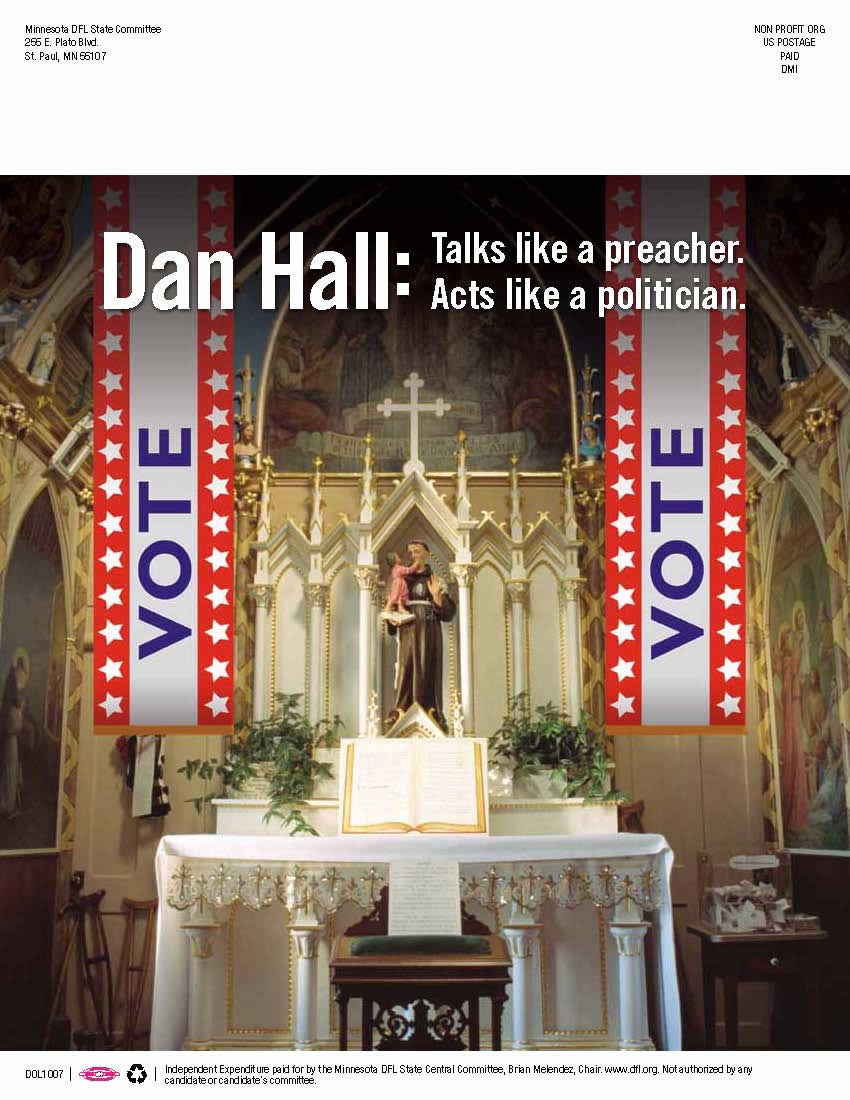
I wrote about perceived anti Catholic tactics by the democrats in Minnesota here. In an update I tried to give them the benefit of the doubt. Today, however, I found a picture of their latest postcard campaign on the web site for the Archdiocese of St. Paul and Minneapolis. It uses a picture of what is clearly a Catholic altar.

The spokesperson for the DFL tries to explain

“When asked if the mailing’s creators considered how offensive the images could be to Catholics and other faith groups and if an apology might be coming from the DFL Party, McFarland said, “Everything that I had to say, I said in the statement I sent. I don’t have anything to add to that.”

McFarland sent the following e-mail to The Catholic Spirit:

“The ad is part of a two-piece mailing that highlights and criticizes the policy views of Dan Hall, a preacher who is the Republican candidate for the Minnesota Senate. I enclose both sides of both pieces. I understand that some Republican bloggers have taken one image from the first piece, and claimed that the mail is somehow anti-Catholic. But the text explicitly criticizes Preacher Hall for distancing himself from policy views that have been taken by the Catholic Archdiocese, by the Lutheran Synod, and other leaders in Minnesota’s faith community. Dan Hall is willing to enlist God and religion in his campaign when it helps him — but in fact, his views hurt the poorest and sickest among us, and this mailing holds him accountable for those views.”

Ok. But if is only directed at Dan Hall, who is a chaplain of a non denominational Church, why use images that are specifically Catholic. Is it a coincidence that the Bishops of Minnesota mailed DVD’s in defense of marriage as between one man and one woman, to all registered Catholics?

Take a look at the picture and let me know what you think:

Posted in Church and the Public Square | 3 Comments

The Pain of Infertility and Facebook Envy

My mother in law had several miscarriages before having her first child. She went on to have five children. But she often talked of how difficult those preceding childless years were especially as she was an older bride.

Get Religion has an interesting post on how happy Facebook pregnancy posts are, to put it mildly, upsetting to friends who are infertile.

“Long ago, during my Denver days, I heard Cardinal J. Francis Stafford — at that time the city’s archbishop — make an amazing statement. He said that priests face many tough issues while trying to comfort those who are making their confessions while dealing with the wreckage caused by events in life that are occurring, literally, through no fault of their own.

In that context, he noted that of all the issues that he had faced through the years when hearing confessions, one of the the issues that consistently had the most devastating effects on the spiritual lives of penitents was infertility.

How serious? Often, he said, the spiritual effects of infertility were even worse than those suffered by those who lost a child to disease or to a tragic accident. There was a unique and silent pain suffered by those who wanted to have children, but could not. Whole communities will rally around those who lose a child. Those who feel denied the unique joys and pains of parenthood often suffer in silence, except for the interior screams of pain that others rarely hear. Clergy must understand this reality and help those who suffer from it, he stressed.

So what does that have to do with the following story from the Post, which is both creative and emotionally gripping? Read on:

Diane Colling, an occupational therapist and fertility patient, was scrolling through her Facebook page last week when, once again, she was bombarded by a friend’s exuberant broadcast about her pregnancy. “Your daughter will hold your hand for a little while, but will hold your heart for a lifetime,” her brother’s pregnant girlfriend posted.

“I know it’s not meant to hurt, but you feel like you’re getting kicked every time you see these,” said Colling, 28, who lives in Baltimore County and has been trying to get pregnant since 2006. “I have to unfriend people for a while. If I was smart, I wouldn’t go on Facebook anymore, but I’d completely lose connections with family and friends.”

Before Facebook, infertile couples could try to avoid pregnant people at work or social gatherings, limiting their exposure to triggers of bitterness or jealousy. But that was when friendships were forged mainly in person, not via today’s social media Web sites, where people can feel ambushed by photos of friends’ – or mere acquaintances’ – baby bumps.

Now, when more than a half-billion people use Facebook, couples yearning for children say they are trapped: They are unwilling to detach from the social network, but unable to avoid its frequent reminders — fetal sonograms are seemingly ubiquitous — of what might elude them forever.”

Infertility is a difficult cross to bear. It is perhaps even harder for faithful Catholics given the prohibition against IVF.

There is just so much pain in the pews. And on Facebook.

Do read the entire Get Religion post.

Posted in Pro life | Tagged , | 5 Comments