20% of Atheist Scientists are Spiritual?

(Newsroom America) — More than 20 percent of atheist scientists are spiritual, according to new research from Rice University. Though the general public marries spirituality and religion, the study found that spirituality is a separate idea – one that more closely aligns with scientific discovery – for “spiritual atheist” scientists.

The research will be published in the June issue of Sociology of Religion.

Through in-depth interviews with 275 natural and social scientists at elite universities, the Rice researchers found that 72 of the scientists said they have a spirituality that is consistent with science, although they are not formally religious.

“Our results show that scientists hold religion and spirituality as being qualitatively different kinds of constructs,” said Elaine Howard Ecklund, assistant professor of sociology at Rice and lead author of the study. “These spiritual atheist scientists are seeking a core sense of truth through spirituality — one that is generated by and consistent with the work they do as scientists.”

For example, these scientists see both science and spirituality as “meaning-making without faith” and as an individual quest for meaning that can never be final. According to the research, they find spirituality congruent with science and separate from religion, because of that quest; where spirituality is open to a scientific journey, religion requires buying into an absolute “absence of empirical evidence.”

“There’s spirituality among even the most secular scientists,” Ecklund said. “Spirituality pervades both the religious and atheist thought. It’s not an either/or. This challenges the idea that scientists, and other groups we typically deem as secular, are devoid of those big ‘Why am I here?’ questions. They too have these basic human questions and a desire to find meaning.” Read more here. H/T Mark Shea

Huh? I  honestly don’t understand how one can believe that there absolutely is no Creator of the cosmos and still be spiritual.  If there is no God then I am here by an impersonal act of nature. My life only has meaning while I exist.  I live on only in the memories of my love ones or any work,art, books, inventions, or theories that outlast my life.

An atheist believes that God is a myth. So how can any non theist believe in the spiritual?  One who is spiritual acknowledges that there is a non corporal non material supernatural reality.

Pray tell how is it possible to be a spiritual atheist?

Oh and how is that more reasonable than the Catholic belief that faith and reason are compatible?


Posted in Atheisn | Tagged , , | Leave a comment

Christianity is a Made Up Religion

And the best conspiracy theory ever!  How to answer an atheist with humor. Way to go Lutherans. H/T The Sacred Page.


Posted in Apologetics, Humor | Tagged , , | 2 Comments

Being Catholic is Not for Wimps

Too often we Catholics forget that it is not just those who come into the Church at Easter who are converts.  Even those of us who came to the baptismal font in our mother’s arms are converts.  At some point we have to decide if we are going to become disciples of Jesus.

But it doesn’t end there. Every day we have to choose between Christ and the world.  And what  a world. It is a world filled with noise, and distractions, and so many lovely temptations. Every day we sin, and we must turn back to the Lord.  We are the Church militant and our lives are a constant battle to choose the narrow way that leads to eternal life.

It is an endless process, and when we get weary we can feel like Sisyphus pushing the bolder up a hill only to have it roll right back down the hill again.   Just when we think that we have this striving for holiness thing down—and start hi-fiving ourselves—we sin. Like Sisyphus we reach the summit only to tumble down the mountain once again.

But unlike Sisyphus our efforts are not pointless.  If we continue to strive to be friends of God we will one day wear crowns of victory in the heavenly kingdom.

A Christian is someone who says yes to God’s love and grace. In his book, Living the Catholic Faith, Archbishop Chaput identifies three requirements for those who choose to accept God’s invitiation to love:

“We need conversion, which means turning away from our sins and toward God; discipleship, which means deciding to obey God by following Jesus Christ in everything we do; and transformation, which means allowing the Holy Spirit to make us new creatures. We become God’s sons and daughters in and through God’s Son. All three of these movements in our hearts—conversion, discipleship, and transformation are continuous throughout a Christians life. They never stop….We can always do more as apostles, and our transformation is never complete until we fully possess God—and are fully possessed by God—in the life to come.”

Without Jesus we would indeed be like Sisyphus.  Jesus gives our life hope and purpose. With God all things are possible.

Catholicism is not for wimps or for people who want to be popular. It is for people who want to really know Jesus. It is for people who don’t mind being called weird, or stupid, or bigots.

Adult converts know this. Most of them have faced rejection and anger as they journeyed toward  Christ’s Church.

Jesus doesn’t want groupies.  He wants people who are willing to give up their lives, pick up their crosses and follow Him.  Jesus doesn’t want us to stay down in the muck and dirt of our sins.  He wants us to be pure and spotless as the day that we were washed clean in the waters of baptism.

It is not an easy life. Continual conversion, transformation, and discipleship hurts. It costs. It involves gut wrenching change. It often involves rejection and even persecution.

When I was a child I learned to roller skate by going down a steep hill. Every day I would fall and skin my knees. But I kept at it until I finally mastered the hill and skating.  I did it by persevering. It was an act of my will. Well being stubborn did help.

We cannot, however, become holy by human efforts alone.

That is why Jesus gave us the sacraments. In confession, Jesus forgives us and restores us.  Jesus nourishes us with his very body and blood in the Eucharist.  The Sacraments give us the strength to keep climbing up the mountain no matter how many times that we fall down.

That is why I chose to be Catholic. It is the easiest way to heaven. That is why Catholic is who I am not what I am.

It is the only way that I know to say yes to God with all my heart.

Posted in Catholic, Discipleship, Holiness, Uncategorized | Tagged , , , | Leave a comment

Bad Liturgical News.

I know, I know. I promised to retire from the liturgical police. But Jimmy Akin discovered something that got my Irish/Italian up. The (US) English translation of the Christmas Proclamation differs significantly from the Latin text. The English translation is political correctness on steroids.

It is, in fact, insulting to mature secure women who do not have a victim complex . Jimmy’s assessment (H/T New Advent):

First and foremost, they wiped out all the specific time expressions in the first part of the proclamation, thus destroying it’s character as a concatenation of different ways of expressing the same year. So that’s violence to the literary form of the text, right there.

Not only do they fuzz out the clarity from these numbers (“untold ages,” “several thousand years,” referring only to centuries rather than years), they also change numbers (they’ve got the Exodus in the 13th century B.C. rather than the 15th century B.C.) and add stuff that isn’t there in the original, and significant stuff, too:

  • “and then formed man and woman in his own image,”
  • “when God made the rainbow shine forth as a sign of the covenant,”
  • “and Sarah,” 
  • “Eleven hundred years from the time of Ruth and the Judges”

Why these things got included is anybody’s guess, though note we’ve worked women into an otherwise male narrative three times (Ruth even gets top billing, though her story comes after the book of Judges in canonical order, and she ordinarily isn’t paired with them). They’ve also included a rainbow, which has not entirely the same significance today that it did in the past.

It’s not hard to see a gender/sexual agenda shaping the translation here.

More:

I understand part of the motive to change the text of the Christmas Proclamation.

The text itself is part of the Roman Martyrology and is based on the Chronology of Eusebius of Caesarea (a.k.a. “the father of Church history”–he lived back in the 300s and attended the first ecumenical council at Nicaea in 325).

The dates he gives for the earlier events in the Chronology are probably not right, and in any event we wouldn’t claim today to be able to establish these dates with the exact precision that he did. In one case–the date of the Exodus–modern biblical scholars have generally dated it a couple centuries after the traditional date.

So rather than confuse people with a bunch of dates that we aren’t that confident of, or that are likely not right, I can understand the motive to revise the text (about the dates, anyway; the other stuff not so much).

And if the Vatican chose to make those changes to the Latin original in the Roman Martyrology, I would not have a problem with it.

My problem is with the translators arrogantly deciding to make the changes on their own–as well as introducing other, apparently agenda-driven changes–into a liturgical text.

This is the kind of stuff we’ve had to live with in English liturgical texts for a long time.

So thank God we’re going to be getting a new, more faithful translation this Advent.

Consider this a Class-A example of why Rome decided we needed a new translation.

But here comes the bad news, folks . . . 

The new translation is of the Roman Missal, not the Roman Martyrology. Since the Christmas Proclamation comes from the Martyrology, it probably hasn’t been retranslated at this point and so come Midnight Mass at Christmas, smack in the middle of the glorious new translation, will be this execrable object.

Probably.

The post is long, but very informative. Jimmy provides the current translation along with a correct one.  Read the post here.

Posted in Catholic, Liturgy | Tagged , , | 1 Comment

Christians Should Weep for Bin Laden

The day after  the death of  Bin Laden, I wrote a post, Should Christians  Celebrate the Death of Bin Laden?”  No. Christians should never rejoice when a human being, made in the image and likeness of God, dies.

Jim Tighe , a deacon candidate, lost a brother on 9/11.  Yet he is not celebrating Bin Laden’s death (H/T Deacon Greg):

“As a disciple of Christ, my life is given to his work. It is the work of bringing people into the light, not condemning them to the darkness. Osama Bin Laden was always easy to condemn into the darkness. On this issue, it is easier to go with the Philadelphia headline “Got the Bastard,” then it is to follow the words of Christ. But I’m going with Christ. This is, as best we know, a lost soul. Nothing to cheer about. That’s not what we do.

This is no way a defense of the man. He chose to live in the darkness. Any condemnation comes not from God but from his own choosing, just like the rest of us. He got what he chose, life in the darkness.

When Christ wept for Lazarus, I’m betting he wept for Bin Laden and people like him as well as for all of us who ultimately face death. I bet he wept for them because of the terrible pain caused by their own choice to remain in the darkness. Do I feel a change now that my brother’s murderer has been found? Yes, but it’s not that false “closure” stuff, but rather a deeper look at my own life and the light and darkness within.”

Read his post and pray for him as he approaches his ordination in May.

Posted in Difficult questions, Discipleship | Tagged , , | 1 Comment

God of the Schizophrenic

David Weiss was diagnosed with schizophrenia and bipolar disorder in the spring of  2005.  He wrote a piece for Christianity Today that is both heartbreaking and inspiring.

I can relate to David encountering God through his pain and suffering.  But there was an experience he described of his Christian community blaming him for his condition that brought back a similar experience that I encountered.

When I was first diagnosed with MS a well meaning person gave me a book that claimed that all illness is due to a defect in character and sin. I threw it in the trash and never told anyone about the book.

It is a long article. Here is the very beautiful and gut wrenching end.  H/T Deacon Greg and  Joe Carter of First Thoughts.

Of course, whether we suffer alone or with others, the question “Why?” will never be answered, at least in this lifetime. Who knows why God allows pain? Who knows why God sometimes seems to leave us alone? People have asked these questions since they first puzzled over the causes of lightning and rain. Bad things just happen, we say, and it isn’t anybody’s fault. There’s no rhyme or reason. But even when we cannot grasp the sources of our misfortunes, we can strive to learn the right lessons.

The most important lesson I have learned from my pain is about compassion. I was once one of the Bible bangers who knew everything and needed nothing. Not anymore. If God isn’t up there in heaven watching and waiting for me to screw up—if instead he weeps when I weep and celebrates when I take just one step toward a new and better life—then who am I to judge others harshly?

When my psychiatrist asked me why I still believed in God, I didn’t have an answer. I still don’t. I still don’t know if the treatment was worth the pain. I have a multitude of problems, not all of them related to mental illness. I am not a prophet who has received great enlightenment. But I do have some hard-fought wisdom to impart.

Though my illness persists, I have finally met the God I had heard about but never truly experienced. A God who heals. A God who loves. A God I cannot logically explain to my psychiatrist. A God who manifests his genius by salvaging good from the evil in our lives. Someone unlike me. Someone unlike the well-meaning inquisitors who judged me and sought to spiritually cure me. Someone I never would have discovered without my affliction.

A God who calls himself Emmanuel—God with us.

Do Read the whole article here. It is worth your time.

Posted in Christianity, Suffering | Tagged , | Leave a comment

Saints of the Day: Philip and James, Apostles

Today the Church celebrates two of The Twelve. You can read about them here.

The Mass readings for today are here.

Video: On Faith AND Works:

Posted in Catholic, Saints | Tagged , | Leave a comment

A Deacon’s Wife Turned One…

yesterday and nobody noticed. Not even me.

Sniff.

My first year of blogging has just zoomed by. It has been fun.

What would you like me to blog on? I can use all of the help that I can get!

Posted in Uncategorized | Tagged | 2 Comments

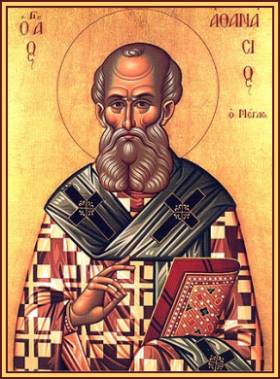
Saint of the Day: Athanasius

From Catholic Culture:

St. Athanasius, Bishop of Alexandria and a great defender of the orthodox faith, throughout his life opposed the Arian heresy. By denying the Godhead of the Word the Arians turned Christ into a mere man, only higher in grace than others in the eyes of God. St. Athanasius took part in the Council of Nicea in 325 and until the end remained a champion of the faith as it was defined by the Council. In him the Church venerates one of her great Doctors. He was subjected to persecutions for upholding the true teaching concerning the person of Christ and was sent into exile from his see no less than five times. He died at Alexandria in 373 after an episcopate of forty-six years. Read more here.

Marcellino D’Ambrosio has a selection of the Saint’s writings (scroll down).

Ignatius Inside Scoop has more on St. Athanasius here.

Posted in Catholic, Saints | Tagged , , | 1 Comment

Jehovah’s Witnesses face gunfire at ‘Catholic home’

File this under how not to handle the evangelist at your door. Engage them. Debate them, say no thanks. But be nice. Handle with Christian love and care.

I have no words:

Rhonda Kalapach believes Jehovah’s Witnesses have no place on her property.

When two of them came to her door, the 60-year-old Monroe County woman asked them to leave. Her husband saw the women from across the street and yelled at them, but they didn’t go.

That’s when her husband, William George Kalapach, came into the home and got his rifle. The women were walking to the car where three other people were waiting, when Kalapach said they weren’t moving fast enough, police said.

Police said he fired four shots into the ground about 11 a.m. Saturday near the car with all five people inside. He is now in county prison, charged with aggravated assault and related charges.

“This is a Catholic home,” Rhonda Kalapach said. “This is a devout home.”

She said the evangelists ignored repeated demands from her and her husband to leave, forcing her husband to react the way he did.

They were at her door about five to 10 minutes before shots rang out, Rhonda Kalapach said.

“I kept telling them this was a Catholic home,” she said. “They were trying to convert me.”  You can read the whole sordid tale here.

 It is never good when people self identify as devout.

Posted in Uncategorized | Tagged , | 5 Comments