She Is Beautiful

The Catholic Church that is.

In an earlier post, The Mystical Body of Christ, I wrote:

“Yes the Church is an institution. As an institution it has a visible reality: Vatican City, Cathedrals, the Pope, Bishops, Priests, Deacons, pews full of sinners and a few saints. The Church has doctrines, dogmas and laws. The visible Church is important because, like the skeleton supports the body, it supports and points to the interior invisible spiritual reality of the Church.

But the Church is so much more than a visible institution. I am not in love with an institution. I am in love with the Church because the Church is Jesus Christ.”

The Church is Jesus Christ, and that is why I will never leave her. No matter what. But  I also love the Catholic Church for her Sacraments that put me in direct contact with the divine. I love the beauty of the mass even when some Priests butcher it, and the songs are unsingable, and/or nearly heretical, and stuck in the 1970’s and 1980’s.

I love the Church because she is the bride of Christ. She is the Church of saints and sinners, scholars and the uneducated. I love the Church because as (supposedly) James Joyce said:

Look Out! Here comes everybody.

Guilty aside. When I was much younger, back in the last century, I went on a James Joyce kick. Meh.  I was young enough and arrogant enough to think that I was smart enough to understand him. Yeah right. Not.

But I digress.

Back to on loving the Church, Anthony Ensolen says it more eloquently. I don’t cry, well rarely and then it is a scary thing, but it did give me a, rather large, lump in my throat.

“I love this Church, this bride, this sheepfold, this ark, this glorious cathedral. I love the soaring visions of blessedness that inspired the glaziers of the rose windows of Chartres; and I love, sometimes I am not sure why, the same Church that has turned louche show tunes into hymns for the common people. I love the Church for which St. Thomas Aquinas wrote his great compendia of theology and philosophy, dictating, it is said, four separate books to four secretaries simultaneously as he paced about his room; and I love the Church that sells simple holy cards to old women who miss their beloved dead. I love the Church that celebrates the sacrament of the altar under Bernini’s baldacchino at St. Peter’s, and in a bamboo hut in Africa; a Church of untold riches, and sometimes terrible poverty. I love a Church great enough to exalt a middle-class girl dying of consumption, a Therese of Lisieux, to the status of doctor, a teacher of endurance and faith amid suffering. I love a Church whose saints shine forth in beauty – a simple Francis of Assisi, hymning the goodness of all creation; a King Louis IX, meting out justice and mercy under a tree in Paris; a Mother Teresa, smiling with kindness upon the destitute and the dying of Calcutta. And I love a Church filled to the clerestory with sinners, some of whom make their silent way to the confessional every month or so, while others err at the margins, looking warily but longingly to their Mother, hoping someday to return home.”

Do read the whole thing here.

Oh and, while I am in a rare sentimental mood, here is a video from Catholics Come home that never fails to give me a wee lump in my throat. 

Posted in The Catholic Church | Tagged , , | 2 Comments

Purgatory Part II

Part One is here

Catholic Understanding of Faith

  1. Catholics and Lutherans agree that we are saved by faith alone. We cannot be justified before God by anything that we do. We are completely dependent on God’s free gift of grace.
  2. Catholics believe that we are given sanctifying grace, justifying grace, by the Holy
    Trinity at Baptism (CCC 1266). Baptism gives us the grace to grow in faith and holiness through the gifts of the Holy Spirit.

Baptism incorporates us into Christ. We are permanently sealed with an           indelible mark. It cannot be erased, but sin can separate us from the divine life. That is we can lose our justification before God. Justification can be restored by the Sacrament of Reconciliation when we lose it due to serious sin.

The Church teaches that faith is a gift which we only lose when we turn away from God. When we sin. Faith cannot be separated from hope and Charity. The Catechism of the Catholic Church states:

1815 The gift of faith remains in one who has not sinned against it. But “faith apart from works is dead” (Jas 2:26): when it is deprived of hope and love, faith does not fully unite the believer to Christ and does not make him a living member of his Body.

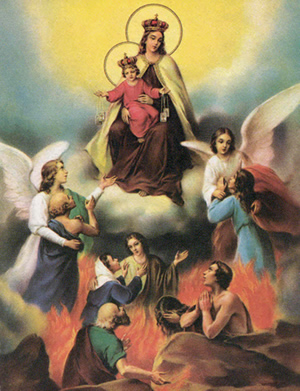
PURGATORY:

Purgatory: “Blessed are the clean of heart for they shall see God” (Mt 5:8); “nothing unclean shall enter [heaven]” (Rev. 21:27)

Created by God’s mercy to purify those who die as friends of God but are not quite ready to stand face to face with God.  Purgatory is not just legal punishment for past sins. It is training for heaven. We are God’s children and Purgatory is the Father’s loving discipline.

Even if we die in God’s grace and friendship, no one who is impure can enter heaven. It burns away our remaining unhealthy attachments to sin and we suffer punishment for any sins that we have not atoned for (even though they have been forgiven).  Purgatory purifies those who at the moment of death are not holy enough for heaven, but are not evil enough for hell. The souls in Purgatory endure suffering, but they also experience Great joy.

Purgatory is the Last Mercy; we are saved even though we need to be cleansed. Purgatory is temporary. All souls that are in Purgatory will obtain heaven. Purgatory is heavens front porch or heavens hospital, or heavens shower. Those in Purgatory have already been saved by their response of faith and their repentance. Their destiny is heaven not hell. There are only two eternal destinations and not three.

Some people obtain heaven without needing Purgatory. There are people who led lives of heroic virtue by striving to be holy.  They include the canonized Saints of the Church.

Where is Purgatory in Scripture? While it is true that the word Purgatory is not in scripture but neither are the words Trinity or incarnation! But the doctrine of Purgatory is supported by scripture.

In the following verse from the Gospel of Matthew, Jesus clearly indicates that some sins will be forgiven in the next world:

Matthew 27: 32-33: Therefore, I say to you, every sin and blasphemy will be forgiven people, but blasphemy against the Spirit  will not be forgiven. And whoever speaks a word against the Son of Man will be forgiven; but whoever speaks against the holy Spirit will not be forgiven, either in this age or in the age to come.

St. Paul tells us:

(1Cor3:10-17) According to the grace of God given to me, like a wise Masterbuilder I laid for no one can lay a foundation other than the one that is there, namely, Jesus Christ. If anyone builds on this foundation with gold, silver, precious stones, wood, hay, or straw, the work of each will come to light, for the Day  will disclose it. It will be revealed with fire, and the fire (itself) will test the quality of each one’s work. If the work stands that someone built upon the foundation, that person will receive a wage. But if someone’s work is burned up, that one will suffer loss; the person will be saved, but only as through fire.

Pope Benedict XVI, in his Encyclical on Hope, Spe Salvi explains:

“Paul begins by saying that Christian life is built upon a common foundation: Jesus Christ. This foundation endures. If we have stood firm on this foundation and built our life upon it, we know that it cannot be taken away from us even in death. Then Paul continues: “Now if any one builds on the foundation with gold, silver, precious stones, wood, hay, straw—each man’s work will become manifest; for the Day will disclose it, because it will be revealed with fire, and the fire will test what sort of work each one has done. If the work which any man has built on the foundation survives, he will receive a reward. If any man’s work is burned up, he will suffer loss, though he himself will be saved, but only as through fire” (1 Cor 3:12-15). In this text, it is in any case evident that our salvation can take different forms, that some of what is built may be burned down, that in order to be saved we personally have to pass through “fire” so as to become fully open to receiving God and able to take our place at the table of the eternal marriage-feast.”

The Church doesn’t know much about the actual workings of Purgatory. Pope Benedict notes that some theologians speculate that Pugatory is Christ himself, and that we will be purified at personal judgment when we die.

“The encounter with him is the decisive act of judgement. Before his gaze all falsehood melts away. This encounter with him, as it burns us, transforms and frees us, allowing us to become truly ourselves. All that we build during our lives can prove to be mere straw, pure bluster, and it collapses. Yet in the pain of this encounter, when the impurity and sickness of our lives become evident to us, there lies salvation. His gaze, the touch of his heart heals us through an undeniably painful transformation “as through fire”. But it is a blessed pain, in which the holy power of his love sears through us like a flame, enabling us to become totally ourselves and thus totally of God.”

Here is a basic article on Purgatory.

Posted in Apologetics | Tagged , , | Leave a comment

Saint of the Day

Sorry about the light posting.  Today is our 37th wedding anniversary, and there is a lot going on.

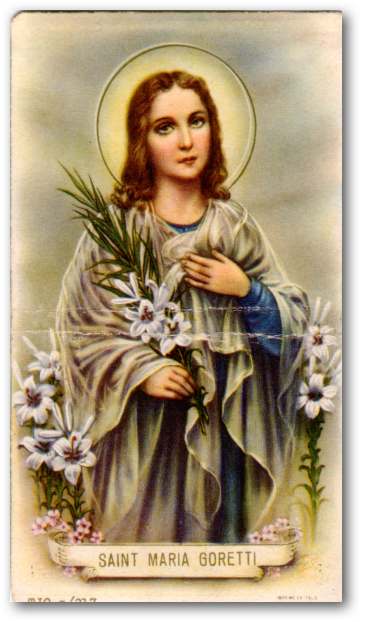
Today we celebrate the feast day of Maria Goretti.  What faith, courage, and forgiveness for a 12 year old to possess.

Posted in Saints | Tagged , | 2 Comments

Saint of the Day

Today is the feast day of St. Anthony Mary Zaccaria.

Love alone is worth everything; any other virtue without love is worth nothing. Sermon 4

Posted in Saints | Tagged , | Leave a comment

Happy Fourth

I probably won’t be able to post on Purgatory until tomorrow morning. In the meantime here are a couple of interesting links:

The Declaration of Independence was the birth certificate of the United States of America. The principles it communicates have informed our history as a free people and inspired our neighbors in other parts of the world to stand up against all forms of tyranny. Catholics who are Americans know all too well the ravages of the “dictatorship of relativism” in our Nation. It is time to take up the task of the New Evangelization in this Nation which we love. It has become mission territory. We are the missionaries. May God Bless America.

Read the rest here

Did you know that there was a Pope that abdicated? I had no idea.

Benedict XVI will return Sunday to the tomb of the only one of his predecessors to abdicate Peter’s Throne, his second visit to the spot in two years.

The Pope will visit the earthquake scourged Abruzzi region of Italy on July 4 and venerate the relics of Celestine V, the 13th-century Pope who abdicated the papacy after only five months.

More here .

Posted in Uncategorized | Tagged , , , | 1 Comment

Purgatory and Justification Part One Update

First we will discuss Justification.

A reader emailed me the following:

Update: I am addressing Justification first because of the content of the email. I just don’t think that I can explain purgatory without first tackling how we are saved.

“My question is, what is  the belief or reason the Catholic Church hangs on to the practice/belief of purgatory. Purgatory would trouble me. I believe that by grace you are saved through faith and that not of yourself, it is the gift of God, not of works, lest any man should boast. Like-end of story. I believe salvation that when Jesus Christ died and suffered for me and AROSE again on the 3rd day-that is all I can bank on for salvation as all my doings are like filthy rags.I am born in sin. He has given me a freedom and now I can go ahead and trust Him to take me with Him to heaven when the trumpet sounds whether i am dead or alive when He returns. I must stop here—please attempt to understand my concerns & curiosity. Much love for all Catholics and I ask God to bless your church as it is doing great things, but purgatory, why???  God’s richest blessings to you and yours as we carry on spreading the gospel and telling the good news of Jesus to those who don’t know Him or maybe don’t care anything about Him. Peace be with you.”

Purgatory is a hard concept for many of our separated brothers and sisters to understand. Unfortunately, after 40 years of poor catechesis, many Catholics think that the Second Vatican Council did away the doctrine of Purgatory. I even had a Catholic who was part of a team responsible for formation tell me that the Church no longer believes in Purgatory. He held fast even when I showed him that the doctrine was in the Catechism!

Just for the record here is what the VII document Lumen Gentium (The Sacred Constitution on the Church) has to say.

“Until the Lord shall come in His majesty, and all the angels with Him and death being destroyed, all things are subject to Him, some of His disciples are exiles on earth, some having died are purified, and others are in glory beholding “clearly God Himself triune and one, as He is”; but all in various ways and degrees are in communion in the same charity of God and neighbor and all sing the same hymn of glory to our God.”

But I digress (getting of soap box now).  There are a few statements in the email that I would like to address because they are essential to understanding the Catholic belief in Purgatory.

First we have to tackle the how we are justified question.

JUSTIFICATION

Our reader asks,

“I believe that by grace you are saved through faith and that not of yourself, it is the gift of God, not of works, lest any man should boast

This gets to the core of the difference/misunderstanding between Catholic and Lutheran beliefs. Lutherans believe in the doctrine of Sola Fide, that is that we are saved through faith alone and not by any thing (works) that we do. We cannot work our way into heaven.

Catholics share this belief.

The Council of Trent (1518) which was called in response the Reformation stated clearly in its first Cannon on justification:

“If anyone says that man can be justified before God by his own works, whether done by his own natural powers or through the teaching of the law, without divine grace through Jesus Christ, let him be anathema.”

The Catechism of the Catholic Church (CCC) states:

161 Believing in Jesus Christ and in the One who sent him for our salvation is necessary for obtaining that salvation. 42 “Since “without faith it is impossible to please [God]” and to attain to the fellowship of his sons, therefore without faith no one has ever attained justification, nor will anyone obtain eternal life ‘But he who endures to the end.'”

On June 16, 1998 the Lutheran World Federation unanimously approved the Lutheran-Catholic Joint Declaration on the Doctrine of Justification. The Pontifical Council for Promoting Christian Unity approved the same Declaration on June 25,1998. Here is an excerpt from the statement:

15.In faith we together hold the conviction that justification is the work of the triune God. The Father sent his Son into the world to save sinners. The foundation and presupposition of justification is the incarnation, death, and resurrection of Christ. Justification thus means that Christ himself is our righteousness, in which we share through the Holy Spirit in accord with the will of the Father. Together we confess: By grace alone, in faith in Christ’s saving work and not because of any merit on our part, we are accepted by God and receive the Holy Spirit, who renews our hearts while equipping and calling us to good works.

16.All people are called by God to salvation in Christ. Through Christ alone are we justified, when we receive this salvation in faith. Faith is itself God’s gift through the Holy Spirit who works through word and sacrament in the community of believers and who, at the same time, leads believers into that renewal of life which God will bring to completion in eternal life.

Catholics and Lutherans have a common understanding that we can only be justified, cleansed of our sins, through faith in Jesus Christ.

Catholics believe that justification comes through faith and  Baptism (CCC #1987,Rm 6:8-11).

Where we differ

But we still have disagreements. Catholics believe that we are made holy by Baptism. Yes we are inclined to sin, but we are not corrupted, by sin.  Christ call us to “be perfect” ( Matthew 5). We were made clean by baptism.  Our sanctity is restored.

When we commit a sin, even a mortal one, we can be restored to union with God. Sin is not a permanent condition. Unless we chose it.

We are not filthy rags.  God made all things good. We are made in the image and likeness of God.  The filthy rag comment from the above reader,  comes from a miss reading of Isaiah 64:6. Please go here for more information. http://www.catholic.com/thisrock/quickquestions/keyword/sola%20fide

Again we are made to live as children of God. We are made in his image. But God also gave us free will. We are free to accept and cooperate with God ; we are also free to reject him. We are free, even after a profession of faith, even after baptism to say no to God.

As St. Augustine said, the fallen angels had faith. They believed. They more than believed because they knew that God existed. Yet they still rebelled.

It takes more than belief to be a disciple. It takes more to live a life of discipleship;

Now we get into complicated territory.

Catholics and Lutherans agree that we are free to reject God. We are free to reject God’s grace. But Catholics also believe that we have to cooperate with God. We have to say yes. Jesus warned us in the Gospel that it is not enough to have faith; it is not enough to believe. It is not enough to be passive. We have to act.

“Not everyone who says to me, ‘Lord, Lord,’ will enter the kingdom of heaven, but only the one who does the will of my Father in heaven. (Mathew 7:21).

Catholics take this very seriously. It makes me quake in my high heeled shoes (from Matthew 25):

When the Son of Man comes in his glory, and all the angels with him, he will sit upon his glorious throne, and all the nations 15 will be assembled before him. And he will separate them one from another, as a shepherd separates the sheep from the goats. He will place the sheep on his right and the goats on his left.

Then the king will say to those on his right, ‘Come, you who are blessed by my Father. Inherit the kingdom prepared for you from the foundation of the world.For I was hungry and you gave me food, I was thirsty and you gave me drink, a stranger and you welcomed me, naked and you clothed me, ill and you cared for me, in prison and you visited me.’

Then the righteous will answer him and say, ‘Lord, when did we see you hungry and feed you, or thirsty and give you drink?

When did we see you a stranger and welcome you, or naked and clothe you?

When did we see you ill or in prison, and visit you?’

And the king will say to them in reply, ‘Amen, I say to you, whatever you did for one of these least brothers of mine, you did for me.’

Then he will say to those on his left, ‘Depart from me, you accursed, into the eternal fire prepared for the devil and his angels.

For I was hungry and you gave me no food, I was thirsty and you gave me no drink,

a stranger and you gave me no welcome, naked and you gave me no clothing, ill and in prison, and you did not care for me.’

Then they will answer and say, ‘Lord, when did we see you hungry or thirsty or a stranger or naked or ill or in prison, and not minister to your needs?’ He will answer them, ‘Amen, I say to you, what you did not do for one of these least ones, you did not do for me.’

And these will go off to eternal punishment, but the righteous to eternal life.”

The Prophet Eziekel (36) foretold that our sanctity would be restored by Christ, through faith and baptism:

I will sprinkle clean water upon you to cleanse you from all your impurities, and from all your idols I will cleanse you.

I will give you a new heart and place a new spirit within you, taking from your bodies your stony hearts and giving you natural hearts.

I will put my spirit within you and make you live by my statutes, careful to observe my decrees.

Christ makes all things new.

We are not filthy rags.

So what about good works? For Catholics doing good works is living the life of love. Of Agape. Of Charity. It is how we cooperate, how we are obedient to God.

We cannot, gosh darn, earn our way into heaven. But we can, by how we live our lives, reject heaven. That is how we end up in hell. Note; The Catholic teaching on hell is that there is a hell. Satan is there. Jesus warned that we could end up there. But we don’t know who if any human being is there. We hope and pray that all are saved.

Part II:  Why Purgatory.

Posted in Apologetics | Tagged , , , | 4 Comments

Faith Seen and Unseen

Blessed are they who have not seen and have believed”

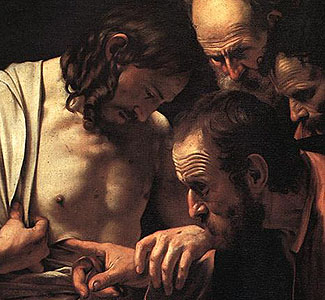
CARAVAGGIO The Incredulity of Saint Thomas

Today is the feast day of  the Apostle, St. Thomas. Poor St. Thomas he gave up everything to follow our Lord, but he is best known for saying the following:

“Unless I see the mark of the nails in his hands
and put my finger into the nail marks
and put my hand into his side, I will not believe.”

When St Thomas sees the risen Christ he declared:

“My Lord and my God”

Almost every commentary has Thomas touching Christ’s wounds, but Johns Gospel says only: “Thomas answered and said to him, “My Lord and my God!”

Almighty Father,
as we honor Thomas the apostle,
let us always experience the help of his prayers.
May we have eternal life by believing in Jesus,
whom Thomas acknowledged as Lord,
for He lives and reigns with You and the Holy Spirit,
one God, for ever and ever. Amen.

Posted in Saints | Tagged , , , | Leave a comment

Wonderfully Made

You formed my inmost being; you knit me in my mother’s womb.I praise you, so wonderfully you made me; wonderful are your works! Psalm 139

Steven Wiltshire from the UK is autistic. H/T Deacon Greg Kandra. He has difficulty communicating, and he lives “in a world of his own. When he was eleven, after one helicopter ride over London, he was able to draw  a perfect aerial view of London. He is known as the human camera.

Every human life is created by God. Every human life is sacred. Every human life has a purpose. If there was a genetic test for Autism, would Steven have been born. I remember reading that in the UK most babies who test positive for Downs Syndrome are aborted.

Please watch this amazing video. Steven’s gift is amazing. Also there are some awesome aerial shots of Rome.

Enjoy!

Posted in Abortion, Cool Stuff | Tagged , , | 3 Comments

Dancing in The Lord

I have the Theology of Staying and over in Washington (DC), Msgr. Pope has a Spirituality of Walking (and dancing).  Have I mentioned how much I love to dance?

Here is an excerpt:

“Dance! In this video I wonder if you might consider a very elaborate form of walking that we call dancing. Now traditional dancing requires an enormous amount of leaning and, especially for the woman, a lot of trust as she allows the man to lead her. She must lean into his moves and follow his direction. In this video the great Fred Astaire and Ginger Rogers dance marvelously. But as you watch this, think of the Lord Jesus leading his bride the Church in a great dance of faith. Consider the trust that is necessary for the Church and for us as individuals as God leads us in the great walk, the great dance that is faith. Only by leaning, trusting and following will our dance ever be “graceful.”  In the final dance move Fred and Ginger leap over the rail of the dance floor and swirl through the doors. So too will we. If we as members of the Bride of Christ will but trust him, follow his lead and lean in the great walk, the great dance of faith we too will leap off the dance floor one day and go through the gates of heaven.

Enjoy this video. It is Fred and Ginger at their finest. And as you watch keep in mind the spiritual image.”

Posted in Uncategorized | Tagged , , , | 2 Comments

Dependence Day

Note: Meager blogging again today. I am working on a post on Purgatory in order to answer a question from a reader that arrived in my in box today.

But here is a great article from Archbishop Timothy Dolan of New York:

Declaring Our Dependence (on God)

“My friend Cardinal Francis George, the Archbishop of Chicago, comments that perhaps the most revolutionary statement we can make these days is the opening line of the creed, “We believe in God, the Father Almighty… ” as we pray at every Sunday Mass.

We look forward to all the festivities of our national holiday, the Fourth of July, this weekend.

We call it Independence Day, celebrating our independence from England, sealed on July 4, 1776, won at the cost of the blood of brave patriots during the Revolutionary War.

However, to profess our faith that “We believe in God, the Father Almighty… ” is actually an act of dependence: we admit that every breath we take, each day we have, every opportunity we are given, come from an omnipotent God, and we bask in the fact that we are totally dependent upon Him. He is sovereign, He is Lord, He has power and dominion. “Without Him, we can do nothing; with Him, nothing is impossible.”

Yes, this spiritual Declaration of Dependence is downright revolutionary. For today, it is chic to throw off—not the shackles of allegiance to King George, as our brave patriots gallantly did—but any sense of obedience to God, His revelation and the basic code of right and wrong He has engraved upon the human heart.

Oh, it’s not that we do not believe in God; it’s just that we consider ourselves to be gods: we claim dominion over life itself, as we accept abortion, euthanasia, destruction of embryonic stem cells, capital punishment and destructive poverty that causes starvation and plagues in the world.

We presume to tamper with the basic institution of a civil society, marriage and family, re-defining it to suit the spirit of the age.

We revel in violence on TV, in movies, in the rap lyrics our young people sing, independent of the decency and respect God has instilled in us.

Creatures resort to war, and terrorism, feeling themselves above the moral limits of conflict that a civilized society has always tried to heed.

We defend freedom as the right to do whatever we want, whenever we want, wherever we want, however we want, with whomever we want, instead of believing that freedom is really the liberty to do what we ought.

The Ten Commandments become a list of suggestions, the Eight Beatitudes a set of nice ideas, the Bible mere literature, the Church unnecessary, religion a crutch for the unenlightened, objective truth an outmoded oppression.

Because, you see, we are independent. We are self-made, and we worship our creator—ourselves!

This is sure curious. For one, we are terribly dependent—not, regrettably, upon God—but upon money, insurance, gas, weapons, security systems or even upon alcohol, pornography, lust, gambling and drugs, in a culture of consumption and convenience.

Two, it is curious because the patriots who won independence for us in 1776 had no trouble at all acknowledging their total dependence upon God. In fact, the normative documents of our beloved country presume the existence of a providential God, objective truth, moral duty and the right to life itself.

The real invitation this Fourth of July is to be independent of earthly and selfish tyranny, whether that be King George, Osama bin Laden, or a slavery to the passions, while at the same time confessing an utter dependence upon God and His eternal law.

“The Truth shall make you free,” as Jesus taught.

Happy Fourth of July!

God bless America!

“We believe in God, the Father Almighty, maker of heaven and earth.” And we will never declare our independence from Him.”

Posted in Discipleship | Tagged , , | Leave a comment