Catholics Are Not Baptized in Vinegar

As we battle the culture of death and relativism, we often forget that the Gospel is the  good news. We forget that where sin abounds, grace abounds more.

Or as I sometimes quip to my dear deacon husband when he is looking glum on the altar:

“Lighten up deacon hon. You were baptized in living water NOT vinegar.”

There is a time for fasting and a time for feasting.

Over at the National Catholic Register, Simcha Fisher has a post up on joyless dour faced Catholics. She begins:

When my son was a toddler, he went through an angry stage. He would step out into the yard, where friendly butterflies kissed the sweet faces of daisies dancing in the golden sunshine. And he would growl, “It is NOT a bootiful day.”

Another time, he was having a temper tantrum in the car. We tried to distract him: “Look at the pretty trees! Oh, look at the cows! Look at the water!” and he would answer us, “I don’t yike the cows.  I don’t yike the water. It’s stupid water. There’s no such FING as water!”

He’s much happier now. But I think of that stage from time to time when I run across a certain type of Catholic. There are frankly heretical movements, like these fellows, who apparently translate “Gospel” as “Bad News.” Here we are in a post-Incarnational world, the gates of heaven are flung open, our Savior is here—and they’re basically growling, “There’s no such FING as grace. And it is NOT a bootiful world.”

You don’t have to be a tinfoil-hatted schismatic to talk this way. There was, for instance, the commenter who responded to my “buy your priest a beer” post. Signing himself “Fr. John,” he growled, Continue reading here.

Oh and do buy your priest a beer, wine, or his favorite tipple.

Posted in Catholic, Christianity | Tagged , , , , | 2 Comments

When Heroes Bite the Dust to Which We Shall Return.

Since becoming a young adult, I have avoided making idols of men and women. Well at least I don’t make heroes or saints out of the earth bound ones no matter how saintly an individual my appear. This is especially true of priests. As I wrote in this post about Fr. Corapi, Look Through the Priest and See Jesus,

Although we do not know if the accusations against Fr. Corapi are true, we should be careful not to put Priests on pedestals. Yes they represent Christ, but they are human. Becoming another Christ is something that Priests have to grow into.

I have avoided commenting on the controversy, because I don’t want to indulge in speculation or, worse, gossip. But I found the level of adoration bestowed on Fr. Corapi  disturbing.  Right now we do not know if the accusations are true or false.

But we do know, despite Fr. Corapi’s faithful witness and teaching, he is a mere human being who sins.  Catholic News Agency, has a thoughtful post up by Rebecca Ryskind Teti:

Another Lent, another dispiriting round of Catholic heroes brought low by their own sins, either actual or alleged.

It seems we are always confronting anew the wisdom of the Psalmist’s admonition “Put not your faith in princes,” to which St. John Chrysostom would add, “…even princes of the Church.”

We know this in theory. Each Lent our congregations swell with people eager to receive ashes and be reminded they are dust. Why are we always so shocked to see the truth of it?

Let me not be misread in what follows to be dismissive of the marvelous variety of Catholic ministries nor anything but admiring of the dedicated people who make them work.

Nor am I suggesting that “do as I say but not as I do” is sufficient morality for catechists, evangelists and consecrated souls. Of course Christians should make every effort to behave in ways worthy of the Savior they proclaim. Those are givens.

Reading through peoples’ strong reactions when persons we’ve admired are shown to have feet of clay,  though, I’m wondering what good might be drawn out these negative situations. And might there be something to learn from the rapid succession of cases in the past few years?

Do we place a weight of expectation on our Catholic heroes that is more than a human being can bear?

It’s obviously not unreasonable to expect a priest to uphold his vows: more like a bare minimum! But if we are looking to human beings to be perfect, aren’t we looking in the wrong place? Why do we think a gift for exegesis or catechesis equates to personal holiness? Do our own personal gifts prevent us from being tempted or falling into sin?

St. Claude Colombiere advises:

“Really humble people are never scandalized: they know their own weaknesses too well; they know that they themselves are so close to the edge of the precipice…that they are not at all astonished to see others do so.” Continue reading here.

Yup. As I have written here,

We are all frauds before God.

Posted in Catholic Church Scandals, Holiness | Tagged , , | 1 Comment

Lord Teach Us To Pray

Why is prayer such a struggle?  It should come naturally, but it seldom does. Well except when we are in really big trouble.  There are many reasons that prayer is a battle. Monsignor Pope has an interesting take in his latest post, How to Organize your Prayer Time According to Jesus.

One of the struggles people often have in praying is that they are not sure what to “do” when they pray. This is especially true for those who want to pray for more than a few moments at a time. Perhaps they have taken up the laudable custom of making a holy hour before the Blessed Sacrament, or of devoting themselves to a half hour of mental prayer each day. It is often helpful to have a structure, for prayer of this sort, and Jesus himself actually gives us one in the Our Father.

I want to recommend for your consideration that the Our Father gives us more than words to say. It also gives us a structure for our prayer life, a basic plan for our spiritual life. It makes sense that when one goes to pray, understanding the basic structure and elements of prayer will be helpful. And the Lord does not disappoint us or leave us unschooled in the basic shape of prayer.

Lord teach us to pray – Consider that, according to Luke, the Lord gave the Our Father, he was responding to a request of the apostles who said, Lord, teach us to pray, just as John taught his disciples (Luke 11:1). They did not ask to be given words to say, but to taught how to pray. Thus, while the words of the Our Father are precious, it is also important to look at the underlying structure implicit in the prayer so as to learn “how to pray.” The insight is that Jesus, more than giving words is illustrating by these words what ought to be going on in us interiorly, in our mind and heart as we pray: Here is what the mind and heart of a person of prayer is like.

Let’s consider then, five basic disciplines, taught by Jesus in the Our Father that form a kind of structure for prayer:

1. RELATEOur Father who art in heaven – Here begins true spirituality: Relate to the Father! Relate to him with family intimacy, affection, reverence and love. We are not praying the “the Deity” or the “Godhead.” We are praying to our Father who loves us, who provides for us and, who sent his only Son to die for us and save us. When Jesus lives his life in us and His Spirit dwells in us we begin to experience God as our Abba, (Father).

As developed in other New Testament texts, the deeper Christian word Abba underlies the prayer. Abba is the family word for the more generic and formal word “father.” When my Father was alive I did not call him “Father” I called him “Dad.” This is really what the word Abba is getting at. It is the family word for Father. It indicates family ties, intimacy, close bonds. Why the word Abba is not used here in the Our Father is uncertain. St. Paul develops the theme here: For you did not receive the spirit of slavery to fall back into fear, but you have received the spirit of sonship. When we cry, “Abba! Father!” (Rom 8:15 ) and here: And because you are sons, God has sent the Spirit of his Son into our hearts, crying, “Abba! Father!”(Gal 4:6 ).

Ask God for the gift to experience him as Abba. At the heart of our worship and prayer is a deep and personal experience of God’s love and fatherly care for us. The first discipline or practice of the Spiritual life is to RELATE to God as to a Father who loves us and to experience him as Abba. Continue reading here.


Posted in Prayer | Tagged , | Leave a comment

The Third Sunday in Lent

A reflection.

Readings: Exodus 17:3-7;Psalm 95:1-2, 6-9;Romans 5:1-2, 5-8;John 4:5-15,19-26,39-42

The Church begins the third week of Lent by celebrating the first of three rites called Scrutinies for the Elect (those who are preparing for Baptism at Easter).   It is a time for the Elect to search deep within themselves to uncover all that is weak and broken and sinful in their hearts.  Like the women at the well in today’s Gospel, they thirst for the life giving waters of baptism. They are hungry for the Eucharist, the true bread from heaven.

In the first reading from Exodus, we find the people grumbling and complaining to Moses.  They are desperate to quench their thirst.  Although God has done great deeds for them and satisfied their hunger with bread from heaven, they still have trouble trusting Him. The desert is a desolate and parched land, and the journey is long and difficult.  So they stumble and fall. They have trouble trusting, and so God instructs Moses to bring forth water from a rock.  The water flowed from the rock yet the people still questioned God’s presence.

In the Responsorial Psalm God urges us to  “harden not our hearts”. We are called to trust God and to believe that he has a plan for our good.  God will do great things for us if we trust in Him.

St. Paul tells us that we can trust in God because of Jesus.  We can stop grumbling like the Israelites in the desert, because we can have certain faith and certain hope through the sacrifice of Jesus Christ. In Him we can achieve peace and stop rebelling.  We can trust because we worship what is  the true, the beautiful, and the good. Trust and worship of God is how we come to have a relationship with Him.

It is impossible to adequately discern the depths of today’s Gospel.  St. John really goes to town on symbolism; there is much hidden meaning to uncover.  Jesus reveals himself to a Samaritan women, a non Jew.  He is tired and thirsty and asks for a drink. But the tables are turned when  he tells her that he is the living water. She asks, “Sir give me this water.” The women knows that only Jesus can quench her thirst.

The woman does not flinch when Jesus reveals her sin. She accepts his judgment and forgiveness. She repents and goes to spread the Gospel to her people.  They believed because of her testimony. Let us pray that we can  repent and seek out the Sacrament of Penance and Reconciliation so that we can  be set free to see Jesus and accept his great mercy. It is only then that our thirst can be quenched.

Posted in Liturgical Year | Tagged , , | 1 Comment

Coming to America…

My son and his family are moving from Scotland to Boston. Hooray! I would be singing Al… all day and night, but it is Lent. So I will Praise God instead.

Can you believe it? We will be able to drive to see them! There will no longer be a great land mass and an ocean between us!

We have known that it was a strong possibility for several weeks, but our son put us under an embargo.

God sometimes answers prayers in unexpected, even weird, ways. My favorite deacon and I have not been able to see our children and grandchildren, who live in Scotland and Ireland, for just under two years.  To say that this has caused profound sadness is an understatement.

I have begged and pleaded with God for a solution. But then I changed my prayer. I just put it in God’s hands and asked for the strength  and grace to deal with being so far away from my children

Not long after I began this prayer, my son called to tell us that he and his lovely wife were planning a major move. To Boston. To the United States.

Well. I thought that we had a better chance of winning the lottery. My daughter in law is Scottish. She has a large family. My son went to college in Glasgow. He has not lived in the US since he was 15. I had thought that they were firmly planted there. Hence I never even day dreamed about the possibility.

But in a not so rare occurrence, I was wrong. My daughter in law sought out a job with her employer, Rolls Royce, in Boston. She is now going to be a senior manager for Rolls Royce Marine. Our son found a good job with a previous employer.  Negotiations are on going, so I can’t say more.

But we are very proud of Sean and Aileen. And did I mention how thrilled that deacon and I are? I will never stop thanking God for his mysterious ways.

Posted in Miracles | Tagged , , | 1 Comment

The Annunciation of the Lord

Today we feast, not fast, as we celebrate Mary’s yes. 

Deacon Fournier via Catholic Online:

March 25 is the Feast of the Annunciation of the Lord in the Roman Catholic Liturgical Calendar. This year, the Solemnity falls during Lent. Canon # 1251 of the Code of Canon Law reads “Abstinence from meat, or from some other food as determined by the Episcopal Conference, is to be observed on all Fridays, unless a solemnity should fall on a Friday. Abstinence and fasting are to be observed on Ash Wednesday and Good Friday.”

So, we do not fast – we feast on Friday. Why? Because the Solemnity takes precedence. It invites us into mystery. The mystery of Mary’s cooperation in God’s plan. Also, our cooperation in God’s plan. In the midst of all of the challenges we face as Catholic Christians in a Culture which has forgotten God, we celebrate God’s loving plan and the remember the heart of the Christian message, conversion through Jesus Christ.

The great event of the Annunciation reveals the path to salvation and to cultural recovery. The little Virgin of Nazareth teaches us how to live our real lives in a real world! When the Angel of the Lord appeared, bearing the message and calling her to a special mission, she said “YES.”  We must say “Yes” as well and believe that “nothing is impossible with God.”  Let’s consider her response to the message: “I am the handmaiden of the Lord; let it be to me according to your Word.” It is in these words that we discover the heart of the Christian vocation.

“What came about in bodily form in Mary, the fullness of the godhead shining through Christ in the Blessed Virgin, takes place in a similar way in every soul that has been made pure. The Lord does not come in bodily form, for ´we no longer know Christ according to the flesh´, but He dwells in us spiritually and the Father takes up His abode with Him, the Gospel tells us. In this way the child Jesus is born in each of us.” Gregory of Nyssa

When Mary spoke those words, human history was forever changed. They came from a deep spiritual reservoir within the heart of a young Jewish girl who was in love with the God of her fathers – Abraham, Isaac and Jacob.  Mary´s “Yes” is called the Fiat:  in Latin, “Let it be done.” Mary´s Fiat was spoken from a heart filled with love for God. In a Biblical context, “heart” is a word that means much more than the fleshy organ at the center of our chest cavity. It refers to our center, the core of each of us, the place where our deepest identity is rooted, and from which our fundamental choices about life are made. Mary´s words proceeded from a humble heart.  Continue reading here.

Posted in Liturgical Year, Saints | Tagged , , | Leave a comment

The Pope John Paul II Musical by Tom Quiner

Tom Quiner is a terrific man, a faithful Catholic, and a gifted musician.  Below is the promo for his musical on Pope John Paul II. If you live in the Des Moines area, or will be visiting for one of the dates, I encourage you to attend.

Posted in Uncategorized | Tagged , , , | Leave a comment

Benedict XVI, Hans Kung and Catholicism’s Future

Reading Hans Kung in the 1970’s nearly destroyed my faith. Reading Pope Benedict drew me back to Christ.

Samuel Gregg, of  the Acton Institute compares and contrasts recent books by the two German scholars.

Excerpt H/T The Pulpit:

After Vatican II, Ratzinger and Kung took very divergent roads. Ratzinger emerged as a formidable defender of Catholic orthodoxy and was eventually elected pope. Kung became a theological celebrity and antagonist of the papacy.

Now both men are in the evening of their earthly days. What, many wonder, occupies their minds at this time of life? In this regard, Jesus of Nazareth and Can the Church still be saved? are quite revealing.

From Jesus of Nazareth’s first pages, it’s clear Benedict is focused upon knowing the truth about Christ as He is rather than who we might prefer Him to be.

Through a deep exposition of Scripture many Evangelicals will admire and a careful exploration of tradition the Eastern Orthodox will appreciate, Benedict shows Christ is who the ancient Church proclaims Him to be – not a political activist, but rather the Messiah who really lived, really died and who then proved his divinity by really rising from the dead.

So what is Kung’s book focused upon? In a word, power. For Kung, it’s all about power – especially papal power – and the need for lay Catholics to seize power if the Church is to be “saved” from sinister Roman reactionaries who have perverted Christianity for centuries.

Leaving aside its cartoon-like presentation of Church history, the Christ of Kung’s book is one who would apparently disavow his own teachings on subjects such as marriage because they don’t conform to twenty-first century secularist morality. Instead, Kung’s Christ faithfully follows the views of, well, progressive post-Vatican II German theologians.

For long-term Kung-watchers, this is nothing new. He’s been playing the same broken record since 1965. And the worn-out tune is that of accommodation: more precisely, accommodation to secularist-progressivism.

Unfortunately for Kung, he has two problems. One is theological. No matter how much scandal has been caused by Borgia popes, inept bishops, heretical theologians, sexually-predatory clergy or sinful laity, the Catholic Church teaches “the gates of hell will never prevail against it.”

In short, the cosmological battle has already been won. Hence the Church isn’t anyone’s to be “saved.” Yes, all Catholics and other Christians continue to sin, but the Church’s survival has been guaranteed by Christ. In that light, the notion the Church needs to be “saved” by late middle-aged dissenting baby-boomers is more than absurd: it’s also arrogant.

Kung’s agenda also has a practical problem. Put simply, it’s failed. Whether it is interpreting Vatican II as a rupture with the past or banalizing the liturgy with clown masses and 1970s music, no-one can plausibly claim the accommodationist project infused life into Catholicism.

Instead, it produced ashes. In much of the West, it facilitated moral relativism, a bureaucratization of church organizations, and the collapse of once-great religious orders into not-especially coherent apologists for name-your-latest-lefty-cause.

In what’s left of accommodationist circles, woe betide anyone who highlights the dark side of the Greens’ agenda, who suggests the Intergovernmental Panel on Climate Change doesn’t share in the charisma of infallibility, or who observes that the small number of non-negotiables for Catholics in political life actually are non-negotiable. To do so is anathema.

Benedict’s vision of the Church is utterly different. It does not indulge the fantasy that a “new church” somehow materialized in 1965. Nor does it hanker after an imaginary 1950s golden age.

Instead it’s a Church focused upon deepening its knowledge of, faithfulness to, and love for Christ. It’s also a Church that engages the world, but is not subservient to passing intellectual-fashion. Finally, it’s a Church which is evangelical in the best sense of the word: proposing – rather than hedging or imposing – the Truth revealed by Christ.

But perhaps the most revealing difference between Benedict and Fr. Kung’s books is the tone. Can the Church still be saved? is characterized by anger – the fury of an enfant terrible who’s not-so-enfant anymore and who knows the game is up: that his vision of Catholicism can’t be saved from the irredeemable irrelevance into which it has sunk.

Jesus of Nazareth, however, is pervaded by humility: the humility of one who approaches human history’s greatest mystery, applies to it his full intellect, and then presents his contribution for others’ assessment.  Read more here.

Exactly. Amen
Posted in Catholic Church, Pope Benedict XVI | Tagged , , | 1 Comment

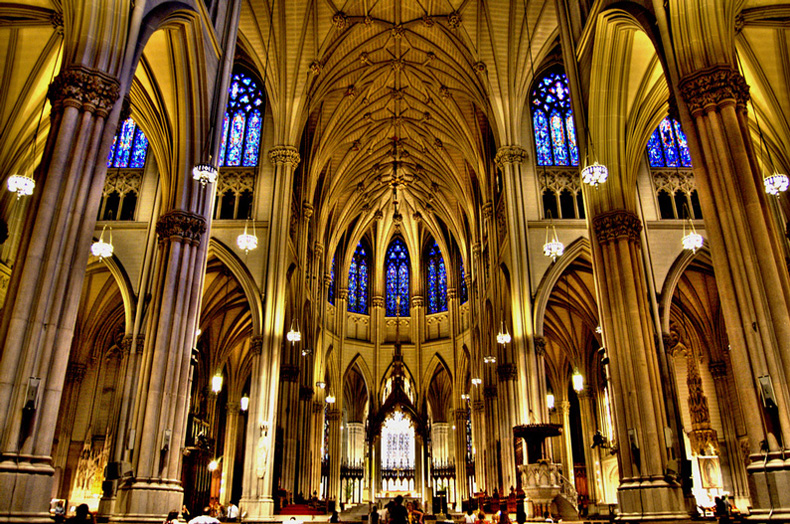
Do Beautiful Churches Produce Vocations?

Father Dwight Longenecker thinks they might along with beautiful liturgy.

Excerpt

We then have to ask what these churches say about the faith, for the church building is a sacramental. It states what we believe. A building, whether we like it or not, is a statement of our values, our faith and our world view. A cheap building with no inner integrity of beauty–a cheap building that is ‘dressed up’ to look Catholic or ‘pretty’ with decorations is superficial and shallow and only skin deep….just like our faith too often I’m afraid! In our superficial, face lift world we build churches that are superficial where the ‘beauty’ is really on ‘pretty’ and skin deep.

What about the liturgy that goes on in such buildings? Too often it also is superficial, sweet and comfortable and skin deep. Does such liturgy and do such buildings inspire vocations? Do they say to our young people, “Look what sacrifices we have made to worship God?” Do they say, “We have given all to build something beautiful for God”? or do they actually say, “It’s okay to give God second best. It’s okay to give him what’s left over.”? Do they come out of the building yawning and wondering what next for Sunday or do they come out full of awe and thankfulness for the beautiful worship of God?

A beautiful church, that required great sacrifice to build, on the other hand–combined with beautiful liturgy and an awesome and reverent worship of God is more likely to inspire the reverence and awe and sacrifice required of our young people who are thinking about a vocation.

Read the whole post here.

What do you think?

Posted in Catholic Church, Vocations | Tagged , , | Leave a comment

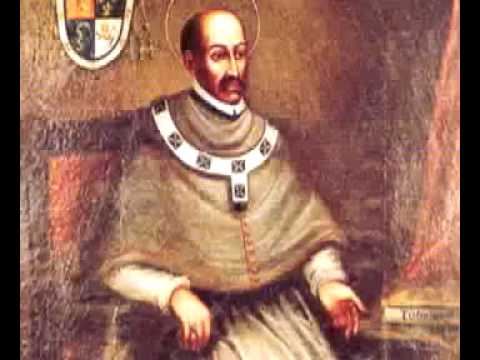
Saint of the Day: Toribio de Mogrovejo, Bishop

VIA Catholic News Agency. Excerpt                                                    

Catholics in Latin America and throughout the world will celebrate the life and ministry of St. Turibius of Mogrovejo on March 23. The 16th century bishop upheld the rights of Peru’s indigenous peoples, and became one of the first canonized saints of the Americas.

Turibius was born in Spain during 1538, to a noble family in the kingdom of Leon. He frequently prayed, fasted, and gave to the poor even as a child, and eventually developed the daily habit of praying the Rosary along with the Little Office of the Blessed Virgin Mary.

He went on to study the law at the University of Salamanca, and was eventually served as a judge for five years in the territory of Granada. His judicial wisdom and diligence drew the attention of King Philip II, who wanted Turibius – who was still a layman – to be consecrated as a missionary archbishop for the Spanish colony of Peru.

Turibius became greatly dismayed, protesting to the king and Church authorities that he was not even a priest and could not possibly accept the charge. In a series of letters, he pled that he was not personally capable of serving as the Archbishop of Lima – nor, he reminded them, did canon law permit a layman to become an archbishop.

Eventually, however, he had little choice but to comply. He was consecrated as a bishop in 1581, at the age of 43, and immediately left for Lima, Peru. Read more here.


Posted in Saints | Tagged , , | 1 Comment