A Presbyterian is in the process of coming into full communion with the Catholic
Vatican City
Church. I can’t imagine the courage it must take for a Protestant to leave his church home in order to become a Catholic. While we can fell great joy we should never be triumphant.
It must be very hard for the church family that he is leaving behind. Please keep David Meyer, his family, and former congregation in your prayers.
David wrote a letter to explain why he is leaving. He writes in part:
According to Sola Scriptura, as defined by Keith Mathison,
Scripture is ‘the sole source of revelation; [the] the final authoritative norm of doctrine and practice; to be interpreted in and by the church, and that it [is] to be interpreted according to the regula fidei.’.
The problem with this doctrine is that when a believer disagrees with the leaders he is supposed to submit to, he then finds other leaders that agree with his interpretation to submit to. This is not submitting to church authority, it is submitting to self. Submitting to yourself is just another way of saying you don’t submit at all! There is a helpful way to remember this concept:
“If I only submit when I agree, the one to whom I submit is me.”
Again please keep him in your prayers. He is leaving his whole world behind. I have heard some incredible conversion stories. Often, those who leave their church for the Catholic Church are ostracized by their friends and sometimes their extended family.
We cradle Catholics often take our faith for granted. But those who enter the Church as Adults, make sacrifices that we cannot truly understand.
Happy Fathers day to all fathers especially my father, husband, brother,son, and son-in-law. And Happy Father’s day to all Priests, who are spiritual father’s , especially Msgr’s. Bognanno and Beeson.
Our culture does not value fatherhood. It underestimates the crucial role that father’s play in their children’s lives.
When Deacon husband is asked for advice on being a good father, his answer is take care of your marriage first; love your wife.
I will never forget the sadness that I felt for an eighth grade girl who told Deacon and me, in religion class, that her father told her that it was impossible for men to be faithful.
Impossible. Gee I know a lot of men who have done the impossible, husband, father, brother, son, son-in law, friends etc.
Here are excerpts from Archbishop (of Denver) Chaputs’ 1999 address, The Importance Of Fathers In Our Search for God:
There’s an old saying that the greatest gift a father can give his children is to love their mother.
That’s the importance of a father: the witness he gives through his love. I have many memories of my own father. But above all, I remember and cherish his love for my mother. I always believed in it, because it was always there. My father taught me that fidelity was not just possible, but a source of joy and freedom, satisfaction and friendship. I might have learned that without him, but not in the same way, and not with the same intimacy. He also taught me how to choose to love. Fathers choose to love and choose to remain with their children in a way mothers do not, because mother-love is frankly just more intense, more natural, more organic. Nothing in fatherhood is as automatic, or as biologically directed, as motherhood. Real father-love is entirely a free-will act of self-sacrifice. Lived well, it gives us a window on God’s own fatherhood.
And:
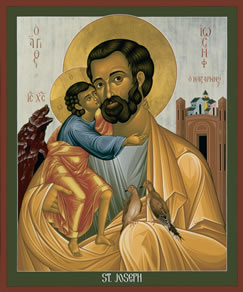
Preparing these remarks, I noticed that I’d be speaking with you on the Feast of St. Joseph the Worker. This is one of my favorite feast days, because Joseph was a man’s man — a man accustomed to labor, sweat and the burden of supporting a family. Scripture says, “Unless the Lord builds the house, those who build it labor in vain” (Ps 127:1). It’s always struck me that God the Father put His only Son into the care of a carpenter, a builder. And Joseph, in his faith and obedience, allowed God to use his own human talents to build the Living Tabernacle. Joseph protected and taught, formed and provided for, the Redeemer of the world.
Joseph was a living witness of the meaning of manliness; the nobility of human labor; and the dignity of married love. Surely, Jesus must have admired and loved him with all his heart. So if we hope to restore the identity of fathers in our families and in our culture, if we hope to rebuild the integrity of family life in our communities . . . we should look first to Joseph.
We have no better model.
Prayer to Saint Joseph for Fathers
Saint Joseph, guardian of Jesus and chaste husband of Mary, you passed your life in loving fulfillment of duty. You supported the holy family of Nazareth with the work of your hands. Kindly protect those who trustingly come to you. You know their aspirations, their hardships, their hopes. They look to you because they know you will understand and protect them. You too knew trial, labor and weariness. But amid the worries of material life, your soul was full of deep peace and sang out in true joy through intimacy with God’s Son entrusted to you and with Mary, his tender Mother. Assure those you protect that they do not labor alone. Teach them to find Jesus near them and to watch over Him faithfully as you have done. Amen. Pope John XXIII
God our Father, in your wisdom and love you made all things.
Bless these men, that they may be strengthened as Christian fathers.
Let the example of their faith and love shine forth.
Grant that we, their sons and daughters, may honor them always with a spirit of profound respect.
Grant this through Christ our Lord.
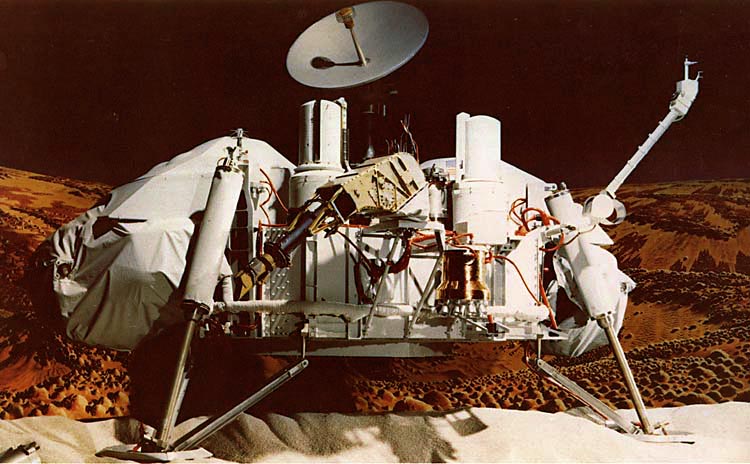
My dad is a retired aerospace engineer. He was involved on many of the manned space missions, Gemini and Apollo for example. It was very exciting to grow up in the time of space exploration especially when you had a Dad who knew the astronauts personally. And Dad came and spoke at school assemblies.
Dad won the Public Service award in 1977 from NASA for his work on the Viking Lander (to mars). You can find it here (his name is Angelo Castro) http://history.nasa.gov/SP-4012/vol4/appa.htm.
But the greatest thing that I learned from Dad, well before John Paul II encyclical on Faith and Reason, was that science and faith are not incompatible.
I remember him teaching me, at a very young age, about the solar system and the Holy Trinity. In my memory, at least, they converge. Anyway, the belief that faith and science, or faith and reason are two sides of the same coin was imprinted in my brain.
Dad taught me a lot. He always told me not to leave the Church because of people. No matter how un-Christian they are. The Church is bigger than that. It is about Jesus Christ. Dad learned that from a Priest that he talked to when he was young and he had a crisis of faith. . That is a Dadism that stuck. I could never use other people as an excuse to leave the Church.
I learned a lot about forgiveness from Dad.
Happy Fathers Day Dad! Thank you for passing on your deep abiding love for God and, to a lesser extent science.
I love you Dad. This one is for You. Thank you for passing on the ancient faith of Our Fathers:
A friend and RCIA team member asks in regard to this post :
Anyway, what does it mean if I am a pro-life Christian and I understand the catechism but I’m not outraged by the execution in Utah? I guess I should be but I can’t muster it?
Good question.
First perhaps “outraged” may be the wrong word. Perhaps a better one is disgusted or appalled by such a barbaric act. We are supposed to be a modern and civilized people.
No. You are not “required” to feel anything. But you are required to reflect on what the Church teaches on the death penalty.
Today, in fact, as a consequence of the possibilities which the state has for effectively preventing crime, by rendering one who has committed an offense incapable of doing harm – without definitely taking away from him the possibility of redeeming himself – the cases in which the execution of the offender is an absolute necessity “are very rare, if not practically non-existent. (CCC #267).
The Church’s position is that while the death penalty is not everywhere and always evil, in the developed world it is not necessary in order to protect society. It is acknowledged, however, that in very rare circumstances that the death penalty is the only way to protect people from dangerous offenders. It may never be used just as a means of punishment or as a deterrent.
The odd thing is that Gardner might have made a good example for legitimate imposition of the death penalty, once upon a time. He had a history of escapes, and, on trial in 1985 for the barroom murder of Melvyn Otterstrom, he was smuggled a gun and shot down an attorney named Michael Burdell in a botched attempt at a getaway from the Salt Lake courthouse. He was an open threat to the public, and the system appeared incapable of containing him. The ordinary course of social justice might well have required his death.
But that was twenty-five years ago. For more than two decades, the Utah State prison proved competent to restrain him—and to age him from the murderous twenty-four-year-old into a less dangerous forty-nine-year old.
There are times when a faithful Catholic can legitimately argue that a specific offender should be executed because he is extremely dangerous, and the state cannot protect society from him.
In the Utah case, however, the state was able for 25 years to protect society. Consequently, the “in order to protect society” loop hole cannot be invoked.
If we strive to think with the mind of the Church, we need to take her teachings seriously even when they go against our feeling or our gut instincts. As the (above) Catechism quote makes clear the reason for opposing the death penalty is because it denies the offender—a human person made in the image and likeness of God—every chance of redemption.
There is the rub. When someone commits a horrible crime the first thought or feeling that comes into our mind is “I hope that he or she rots in hell” or “I hope he gets what is coming to him”.
We are not responsible for the random thoughts and feelings that pop into our heads. But that is where the cardinal or human virtues kick in. Cardinal virtues are acts of human will that, over time cause us to master our wills. The Catechism of the Catholic Church explains:
1804 Human virtues are firm attitudes, stable dispositions, habitual perfections of intellect and will that govern our actions, order our passions, and guide our conduct according to reason and faith. They make possible ease, self-mastery, and joy in leading a morally good life. The virtuous man is he who freely practices the good.
The moral virtues are acquired by human effort. They are the fruit and seed of morally good acts; they dispose all the powers of the human being for communion with divine love.
In other words, because man is inclined to commit sinful acts, we are required to do the hard work of discipleship. In order to strive to be holy, in order to become another Christ we have to use right reason in order to tame our sometimes un-Christian thoughts and instincts.
So when my first thought is hang um and hang um high, I try and reign myself in by stopping to pray for the person in question. I should never wish harm to others even when they harm others. I should never wish that a person, even one that has harmed me greatly, would go to hell.
We are called to forgive our enemies. Very often this is only possible with the help of God’s grace. Often it can take years of persistent prayer.
I know from personal experience that forgiveness is often very, very difficult. But that is a subject for another post.
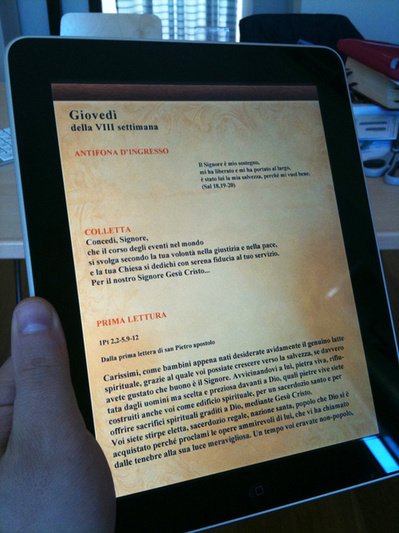
iBreviary–the daily prayer book for iPhone–will become a full Roman missal for iPad, allowing priests to celebrate mass in English, French, Spanish, Italian, and Latin. The Vatican-sanctioned application, created Padre Paolo Padrini, includes:
• Texts of the Mass
• The readings of the Mass
• The breviary
• The stories of the saints
• The main Catholic prayers
• Rites of the Catholic celebrations (anointing of the sick, weddings, funerals, etc.) H/T Deacon Kandra I really want the iPad. But not for Meeeeeeeeeeee. It is for my Deacon. To make his life easier. Not because I love gizmos. Never! It is for my husband.
They did it, the blood-hungry fools. Last night, just after midnight out in Draper, Utah, they trussed up Ronnie Lee Gardner like a scarecrow, pinned a target on him, and pumped four .30-caliber bullets into his chest.
This execution was so unnecessary, and because it was unnecessary, it was simply and completely wrong. They shouldn’t have done it—because they didn’t have to do it.
Exactly. “They didn’t have to do it”. While the execution of criminals is not considered an intrinsic evil (always wrong no matter what the reason or outcome), it is only allowable under the provisions of the Just War Theory. This means that it is only morally permissible if executing a person is the only way to protect society.
The Catechism of the Catholic Church states:
2267 Assuming that the guilty party’s identity and responsibility have been fully determined, the traditional teaching of the Church does not exclude recourse to the death penalty, if this is the only possible way of effectively defending human lives against the unjust aggressor.
If, however, non-lethal means are sufficient to defend and protect people’s safety from the aggressor, authority will limit itself to such means, as these are more in keeping with the concrete conditions of the common good and more in conformity with the dignity of the human person.
Today, in fact, as a consequence of the possibilities which the state has for effectively preventing crime, by rendering one who has committed an offense incapable of doing harm – without definitely taking away from him the possibility of redeeming himself – the cases in which the execution of the offender is an absolute necessity “are very rare, if not practically non-existent.
There is no justification for the execution of Gardner. Period. Every Prolife Christian should be outraged.
Agnus Dei Mozart Requiem
The lyrics in English:
Lamb of God, who takes away
the sins of the world,
grant them eternal rest.
Lamb of God, who takes away
the sins of the world,
Grant them eternal rest.
Lamb of God, who takes away
the sins of the world,
grant them eternal rest forever.
I remember certain parts of Scripture where there is food involved. That’s sort of what keeps me interested in what I am doing if I am having a low point, ” said the Upperline’s longtime chef. “We come into the world needing nourishment to survive and grow and for our existence, to keep us going. It has a purpose, and it has a purpose that can be traced way back to when Jesus was here.”
Anyone who has tried Smith’s food at the Upperline — the dark, dense gumbo, the nostril-flaring Gulf shrimp piquant, the duck-andouille etouffee that is filling in more ways than one — should not be surprised to discover there is a spiritual component to his cooking. Upperline owner JoAnn Clevenger, who has worked with Smith for nearly 20 years, was still shocked late last month when Smith told her he was leaving the kitchen behind to become a priest.
I love reading unusual vocation stories. This one particularly interests me, because I am a wannabe cook. I dabble in the art. I think that feeding people is important in ministry—even if it is just coffee and doughnuts after mass. It is essential to youth ministry. Like the army, the youth group marches on their stomachs.
It seems that the religion of candidate for Governor of South Carolina is confusing the news media. Nikki Haley is a convert to Christianity from Sikhism.
Still, some voters were confused by Haley’s campaign Web site, thinking she may be both Sikh and Methodist and were unclear which “Almighty God” Haley was referencing on the site. (Sikhs, like Christians, believe in one omnipotent God, but not the same God.)
The reality is that there is only one God. Jews, Muslims, Sikhs, and Christians all worship the one true God. It is just that all faiths do not contain the fullness of God which is found in Christianity and the understanding that God is one but a Trinity of persons.
Update: My brother, who is no longer Catholic and disagrees with me on, well, just about everything, sent me the following in an email:
Well….I do love you so I will tell you this. In your latest Blog post I think you were missing the two words I bolded below. Actually, I like it without the added words but the whole sentence doesn’t really work without adding those words and I think it is what you meant.
He is a great and generous guy. Thanks Bro. I dub you Sir Editor in Chief. Anyway, I made the corrections. They are in bold face. Thank you.
This question comes up frequently in the Rite of Christian Initiation of Adults (RCIA) . The RCIA is the usual process for those who wish to become Catholic. The Sacrament of Penance and Reconciliation (AKA Confession) is difficult for many non Catholics to understand. It is the one that they are afraid of receiving for the first time.
The most common question is “Why can’t I just go directly to God? Well in the Sacraments we are going directly to God. All Sacraments are actions of Christ. It is Christ who acts through the Priest.
First it is important to understand that all revelation comes to the Church through Jesus Christ. Christ is the one true source. But there are two ways that God reveals himself: through Scripture and Holy Tradition. Tradition is what has been taught, orally and in writing, by the Apostles and their successors, the bishops. The interpretation of revelation has been entrusted to the Magisterium which is the teaching office of the Church.
From Scripture
Matthew 16:18-19 And so I say to you, you are Peter, and upon this rock I will build my church and the gates of the netherworld shall not prevail against it. I will give you the keys to the kingdom of heaven. Whatever you bind on earth shall be bound in heaven; and whatever you loose on earth shall be loosed in heaven.”
John 20:22-23 And when he had said this, he breathed on them and said to them, “Receive the holy Spirit. Whose sins you forgive are forgiven them, and whose sins you retain are retained.”
From Holy Tradition
Fathers of the Church
John Chrysostom:
“Priests have received a power which God has given neither to angels nor to archangels. It was said to them: ‘Whatsoever you shall bind on earth shall be bound in heaven; and whatsoever you shall loose, shall be loosed.’ Temporal rulers have indeed the power of binding; but they can only bind the body. Priests, in contrast, can bind with a bond which pertains to the soul itself and transcends the very heavens. Did [God] not give them all the powers of heaven? ‘Whose sins you shall forgive,’ he says, ‘they are forgiven them; whose sins you shall retain, they are retained.’ What greater power is there than this? The Father has given all judgment to the Son. And now I see the Son placing all this power in the hands of men [Matt. 10:40; John 20:21–23]. They are raised to this dignity as if they were already gathered up to heaven” (The Priesthood 3:5 [A.D. 387]).
1446 Christ instituted the sacrament of Penance for all sinful members of his Church: above all for those who, since Baptism, have fallen into grave sin, and have thus lost their baptismal grace and wounded ecclesial communion. It is to them that the sacrament of Penance offers a new possibility to convert and to recover the grace of justification. The Fathers of the Church present this sacrament as “the second plank [of salvation] after the shipwreck which is the loss of grace.”
The Power of Sacraments
Sacraments are real actual encounters with God through Jesus and the actions of the Holy Spirit. We say that they are out ward signs that point to an invisible reality. This means that water, bread, wine, oil, for example, that are used in the Sacraments show us that God is actually touching us. We really receive God. They are visible external signs of what God is doing to us in our souls. Sacraments are the most real things that we participate in. Through the Sacraments we are given the most real gift that we can receive.
So Sacraments are not magic spells, or mere rituals, or nice blessings. They are where we meet God. Really. Heaven and earth touch. God uses material things water, wine, bread, oil to be with us. We are embodied souls. So he touches us in a physical way. The incarnation– God becoming man to reveal himself to us is at the heart of the Sacraments..
This is all really nice you might be thinking.
But why does the Catholic Church think that this Sacrament is necessary?
The Sacrament has several Names. It is called the sacrament of:
Conversion: It makes the call to conversion and transformation a real encounter with Christ. It is Jesus who forgives us. It is Jesus who heals us. It is Jesus who gives us grace and hope.
Penance because we are called to make amends for our sins and to transform our lives. This involves a conversion of the heart. If all we do is outward Penance it is a sterile penance—a false penance. When our hearts become hardened by sin, we ask God for a new heart. We ask God for a heart of love. All sin is a failure to love.
Confession because we freely admit that we have sinned. We have turned away from God. Confession to a Priest is essential to this Sacrament. He acts in the person of Christ. When we go to confess our sins, we realize the great mercy of God.
Forgiveness, through the actions of Christ in the person of the Priest we have the peace and joy that God has forgiven us.
Reconciliation. We know that no matter how grave our sin, that God has taken us back. We can once again be in union with the holy Trinity and the whole body of Christ. We also receive the grace to resist sin.
We come to Christ, in the person of a priest, to ask for forgiveness, pardon, and mercy for turning away from Christ. We come to be reconciled with Him and his Church. When we sin we cause harm to the whole Body of Christ.
But we also come to receive the grace and strength to stop sinning and to transform our lives so that we can become holy.
God is the source of this process of Conversion. God never tires. His Love never ends. He is constantly calling us back to him. He waits for us. He changes our hearts. We fall to our knees. We hear the call to confess our sins and turn back to God. When we come face to face with God’s Word, we become aware of our deficiencies and true needs.
We feel—deep within us—the need to become different, to act better, to become holy. We learn to walk in the light of the Lord.
This process of conversion is a real encounter with God. It becomes real through the Sacrament of Reconciliation and Penance. The words that we speak to the confessor is most of all a prayer, because they are addressed to God.
In confession we are given the grace to hate what God hates and to turn away from what displeases God. St. Augustine said sinners have spoiled God’s image in themselves:
Having become unlike God, you look at yourself and you don’t like yourself; you begin then to become like him because what displeases God displease you.
And so we repent and we hear God’s call to conversion and transformation.
St. Augustine also said that Confession is a prayer of Praise—or it is not a sacramental act. We proclaim the great love and mercy of God.
The Words of Absolution say it all:
God, the Father of mercies,
through the death and the resurrection of his Son has reconciled the world to himself
and sent the Holy Spirit among us
for the forgiveness of sins;
through the ministry of the Church
may God give you pardon and peace,
and I absolve you from your sins
in the name of the Father, and of the Son and of the Holy Spirit.
A little Catholic humor. This is just for fun. This could never ever happen.






 A Deacon's Wife